
India does not have a racism problem alone it has a hypocrisy problem. We demand respect for identity when it suits us and dismiss dignity when it doesn’t. If a Northeast Indian can be called “Chinky” without consequences, then every slogan about unity is a lie.
Angel Chakma Case: A Fatal Assault and the Question of Racial Violence in India
Angel Chakma, also known as Anjel Chakma, was a 24-year-old MBA student from Tripura and the son of Tarun Chakma, a serving jawan of the Border Security Force posted in Manipur. Angel belonged to the Chakma community, which is officially recognised as a Scheduled Tribe in India. At the time of the incident, he was pursuing his postgraduate management studies in Dehradun, Uttarakhand, with aspirations of a professional career.
The Incident
On December 9, 2025, Angel and his younger brother Michael were in the Selakui (also referred to as Silakoi) area of Dehradun, purchasing household items. During this routine activity, they encountered a group of intoxicated men who allegedly began abusing them verbally.
According to the family’s account, the men used derogatory and identity-based slurs such as “Chinese” or “chinky,” targeting the brothers for their Northeast Indian appearance.
When the harassment intensified, Angel intervened to shield his brother and asserted their identity, reportedly stating, “We are Indians, not Chinese.” This confrontation quickly escalated into extreme violence.
Angel was attacked with knives and iron rods, suffering severe injuries to his head, neck, spine, and brain. Medical assessments later revealed a fractured neck bone and paralysis on the right side of his body.
Angel was admitted in critical condition to Graphic Era Hospital, Dehradun. Despite prolonged medical treatment, he succumbed to his injuries after approximately 16–17 days, passing away on December 25–26, 2025.
Arrests and Legal Action
Following the incident, Uttarakhand Police arrested five individuals, including three adults and two minors. The minors were sent to a juvenile reform facility.
One accused, described in several reports as the prime suspect, fled to Nepal and remains absconding. Authorities announced a ₹25,000 reward for information leading to his arrest, and a police team was reportedly dispatched for coordination across the border.
A Special Investigation Team (SIT) was constituted to investigate the case. Charges were registered under the Scheduled Castes and Scheduled Tribes (Prevention of Atrocities) Act, 1989, as well as the Protection of Civil Rights Act, 1955.
On December 30, 2025, the National Human Rights Commission (NHRC) took cognisance of the matter and issued notices to the Dehradun District Magistrate and the Senior Superintendent of Police, directing them to submit a detailed report within seven days.
Official Statements and Dispute
While the Uttarakhand government, led by Pushkar Singh Dhami, assured strict action against those responsible and announced ₹4.12 lakh in financial assistance to the bereaved family, statements from senior police officials sparked controversy.
Dehradun SSP Ajay Singh stated that preliminary findings did not conclusively establish racial intent and noted that the formal complaint was lodged nearly 24 hours after the incident.
Police also suggested that the alleged slurs were made “in jest,” describing the episode as a misunderstanding rather than a racially motivated attack.
These claims were strongly contested by Angel’s family, eyewitness accounts, and civil-rights groups.
Public Response and Broader Impact
Angel Chakma’s death triggered widespread outrage, particularly across Northeast India.
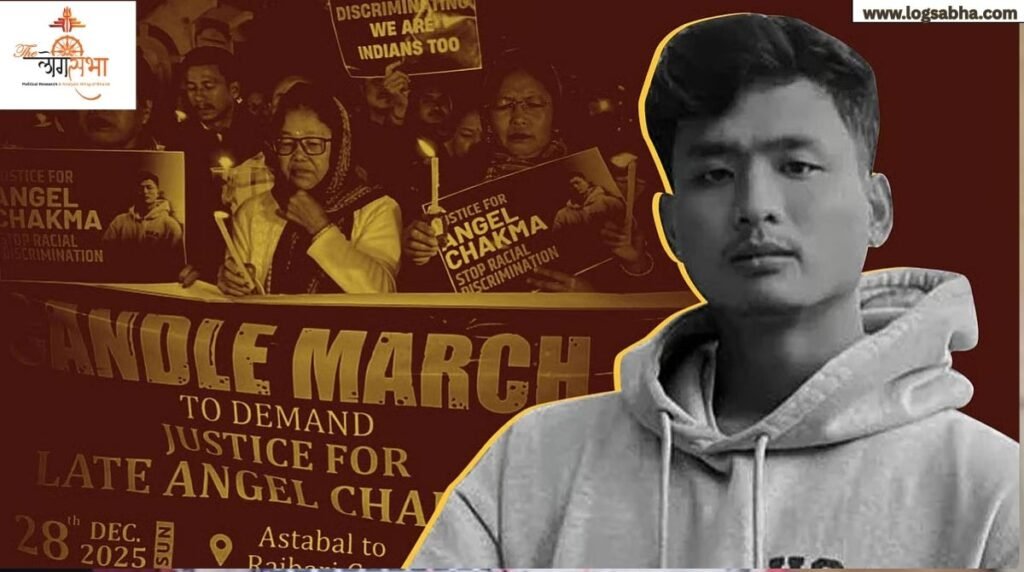
In Tripura, candlelight marches and demonstrations were organised by student unions and civil society organisations, including the Tripura Indigenous Students Federation. Protesters carried placards stating, “Justice for Angel Chakma” and “Stop racial discrimination We are Indians too.”
Angel’s brother Michael publicly shared his account of the assault, and tributes circulated widely across social media platforms.
The incident reignited national debate on entrenched racial prejudice against people from Northeast India, who frequently face stereotyping, abuse, and exclusion due to their physical features.
On January 1, 2026, former Uttarakhand MP Tarun Vijay visited Tripura to meet the bereaved family and express solidarity. During the visit, he also met Indrasena Reddy Nallu and Manik Saha.
Significance
The killing of Angel Chakma has come to represent more than a single criminal case. It has exposed enduring questions about racial discrimination, institutional accountability, and the lived reality of Northeast Indians in other parts of the country.
As the investigation continues, the case remains a test of whether India’s legal and administrative systems can confront violence rooted in identity with honesty, urgency, and justice.
Protests Erupt Nationwide After Angel Chakma’s Death
The death of Angel Chakma on December 26, 2025, following injuries sustained in an alleged racially motivated attack in Dehradun, triggered widespread protests across India.
Beginning in late December 2025 and continuing into early January 2026, demonstrations were held across Northeast states and major urban centres, demanding justice, accountability from authorities, and stronger legal protection against racial discrimination faced by people from Northeast India.
The protests—ranging from candlelight vigils and torch rallies to foot marches and sit-ins—were organised by student unions, political youth wings, and community organisations.
Public anger intensified amid allegations of delayed FIR registration, police statements minimising the racial nature of the attack, and the continued absconding of the prime accused.
As of January 6, 2026, protests remained ongoing in several locations, accompanied by calls for a CBI investigation and the harshest punishment for those responsible.
Major Protest Centres Agartala, Tripura
Agartala became the focal point of the movement. From December 28, 2025, student bodies and community groups organised repeated candle marches and torch rallies, condemning racial violence and demanding justice for Angel.
Organisations such as the Tipra Indigenous Students Federation, Youth Congress, and North East Youth Coordination Committee led large demonstrations, warning of intensified agitation if justice was delayed.
Protesters carried placards reading “Justice for Angel Chakma” and “Stop racial discrimination we are Indians too.”
Dehradun, Uttarakhand
In Dehradun, Northeast Indian students held a candlelight march at Ghantaghar on December 31, 2025, protesting racial abuse and demanding an impartial investigation.
On January 3, 2026, the Indian National Students’ Union organised a foot march, rejecting police claims that ruled out racial motivation and echoing the family’s demand for justice.
New Delhi
A peaceful protest at Jantar Mantar on December 31, 2025, drew participants from diverse backgrounds, including large numbers of Northeast students.
Demonstrators condemned racism, called for swift justice, and urged stronger hate-crime legislation. Slogans such as “End Racism Now” and “Northeast Is Not Outside India” underscored the central message of inclusion and equality.
Kolkata, West Bengal
Candlelight marches and vigils were organised on December 31, 2025, and January 2, 2026, by Youth Congress and NSUI-affiliated student groups in North and Central Kolkata.
Protesters criticised political silence on racial violence and demanded accountability from the authorities.
Lucknow, Uttar Pradesh
On January 2, 2026, youth wings of the Samajwadi Party held a candle march at Hazratganj Crossing, condemning the killing and demanding justice for Angel’s family.
Pune, Maharashtra
On January 3, 2026, more than 200 people gathered for a vigil organised by the North East Communities of Pune, highlighting Angel Chakma’s death as part of a wider pattern of prejudice against people from Northeast India.
Wider Significance
The nationwide protests reignited debate on the persistent racism faced by Northeast Indians, often subjected to slurs linked to their physical features.
Angel’s family—his father, a serving jawan of the Border Security Force, and his brother Michael—publicly demanded a CBI probe, alleging that crucial aspects of the case were being downplayed.
Amplified by social media campaigns such as #JusticeForAngelChakma, the movement has grown into a broader call for institutional accountability, police sensitisation, and comprehensive anti-racism measures.
For many, the protests represent not only a demand for justice for Angel Chakma, but a collective refusal to accept racial discrimination as a normalized reality in India.
Racism Against Northeast Indians in India: A Decade Overview (2015–2025)
Over the past ten years, people from Northeast India have faced persistent racial discrimination across multiple Indian cities.
Rooted largely in stereotypes tied to physical appearance, this prejudice has manifested through racial slurs such as “Chinky,” “Chinese,” and during the COVID-19 pandemic, “Corona.” The abuse has ranged from verbal harassment and denial of services to physical assaults and, in extreme cases, fatal violence.
Urban centres including Delhi, Bengaluru, Mumbai, and Kolkata frequently feature in reported cases. A recurring pattern across incidents is institutional failure—police reluctance to register FIRs, pressure on victims to “compromise,” and the absence of a comprehensive anti-racism or hate-crime law, despite recommendations such as those made by the Bezbaruah Committee (2014).
Studies and civil-society surveys suggest widespread underreporting. Approximately one-third of victims do not file complaints, and many who attempt to do so face refusal or discouragement from law-enforcement authorities.
2015–2019: Normalised and Underreported Discrimination
Before the pandemic, racism against Northeast Indians was often subtle but deeply entrenched.
Migrants and students routinely encountered housing discrimination, workplace bias, sexual harassment, and racial slurs. Women faced heightened vulnerability, with cases of sexual violence and intimidation reported in several cities.
Although fewer individual cases from this period are precisely documented, civil-rights groups highlighted serious incidents, including murders and sexual assaults, that failed to result in meaningful legal outcomes.
Public protests occurred, but the absence of race-specific legal frameworks limited accountability.
2020: COVID-19 and the Surge in Racial Targeting
The COVID-19 pandemic marked a sharp escalation in racial hostility. Northeast Indians were widely profiled as virus carriers because of their appearance.
A government-linked study later found that 78% of victims linked discrimination directly to physical features, with metropolitan cities reporting the highest incidence.
Throughout 2020, numerous cases were reported across Delhi, Gujarat, Maharashtra, Karnataka, and West Bengal.
Victims were:
-
Followed and spat upon
-
Verbally abused in public spaces
-
Denied entry to shops
-
Forcibly evicted from rented homes
-
Physically assaulted in several cases
Police responses were often inconsistent, focusing on quarantine or “law and order” rather than addressing the racist nature of the acts.
Helplines and student organisations reported a dramatic increase in distress calls, reflecting how racial prejudice intensified during a period of public fear and misinformation.
2021–2024: Persistence Beyond the Pandemic
While pandemic-specific abuse gradually declined, racial discrimination did not disappear.
Studies conducted after 2021 showed that prejudice continued in everyday interactions—particularly in:
-
Housing
-
Employment
-
Public transport
-
Policing
Public insensitivity and lack of institutional accountability remained key drivers.
For women from the Northeast, racial abuse continued to intersect with gender-based harassment, reinforcing structural vulnerability.
2025: Angel Chakma Case and Renewed National Attention
In December 2025, the death of Angel Chakma, a student from Tripura, following an alleged racially motivated attack in Dehradun, reignited national debate.
The case triggered:
-
Widespread protests
-
Renewed demands for justice
-
Calls for police accountability
-
Demands for an independent investigation
It underscored that racial violence against Northeast Indians remains unresolved and, at times, lethal.
Broader Implications
A decade of incidents reveals that racism against Northeast Indians in India is not isolated or incidental—it is systemic.
Despite existing legal provisions that criminalise hate speech and derogatory acts, enforcement remains weak and inconsistent.
Activists and scholars argue that India must confront internal racism directly through:
-
A dedicated anti-racism or hate-crime law
-
Mandatory police sensitisation
-
Stronger accountability mechanisms
-
Inclusion of Northeast Indian history and culture in education
Entry Controls and Land Ownership Restrictions in Indian States: A Clear Overview
India’s Constitution grants special protections to certain states—mainly in the Northeast and Himalayan regions—to preserve indigenous cultures, tribal land rights, local demographics, and fragile ecologies.
These protections operate through:
-
Entry regulations (such as the Inner Line Permit)
-
Restrictions on land ownership by non-residents or non-tribals
They are backed by constitutional provisions like Articles 371A, 371F, 371G, and state-specific land laws.
Importantly, these measures do not bar Indian citizens from living, working, or renting property in these states. Instead, they regulate entry duration and long-term settlement, especially through limits on land ownership.
States Requiring Inner Line Permit (ILP) for Entry
The Inner Line Permit (ILP) is a document required for Indian citizens from other states to enter certain protected regions.
Introduced during British rule under the Bengal Eastern Frontier Regulation, 1873, it is retained to protect tribal communities and sensitive border areas.
ILPs are typically valid for 15–30 days and can be extended.
Arunachal Pradesh
ILP is mandatory for all non-residents across the state.
The protection is reinforced under Article 371H to safeguard tribal land, culture, and demographics.
Foreigners require a Protected Area Permit (PAP).
Nagaland
Under Article 371A, ILP applies statewide to preserve Naga customary laws and land ownership systems.
Mizoram
Enforced under Article 371G, ILP is required for non-residents.
Short stays are permitted; longer stays need sponsorship or special approval.
Manipur
ILP was extended to the entire state in 2019 to address demographic concerns.
Brief airport transits may be exempted, but extended stays require permits.
Note: Certain border pockets in Uttarakhand are protected for foreigners under separate rules; there is no statewide ILP for Indian citizens.
States with Restrictions on Land Purchase by Outsiders
Several states restrict or prohibit land ownership by non-residents, non-domiciles, or non-trib tribals. Renting property is generally allowed, but ownership—especially of agricultural or tribal land—is tightly regulated.
Himachal Pradesh
Under Section 118 of the Himachal Pradesh Tenancy and Land Reforms Act, outsiders need government permission to buy agricultural or horticultural land. Residential purchases are also regulated.
Uttarakhand
Amendments approved in 2025 restrict outsiders from purchasing agricultural land in most districts. Residential plots in hill districts are capped at 250 sq m and require district approval.
Sikkim
Article 371F limits land ownership to Sikkimese residents holding a Certificate of Identification. Outsiders cannot purchase land; even leasing needs approval.
Meghalaya
The Meghalaya Land Transfer Regulation Act, 1971, bars non-tribals from owning land in most of the state. Only Khasi, Jaintia, and Garo tribals can own land freely.