

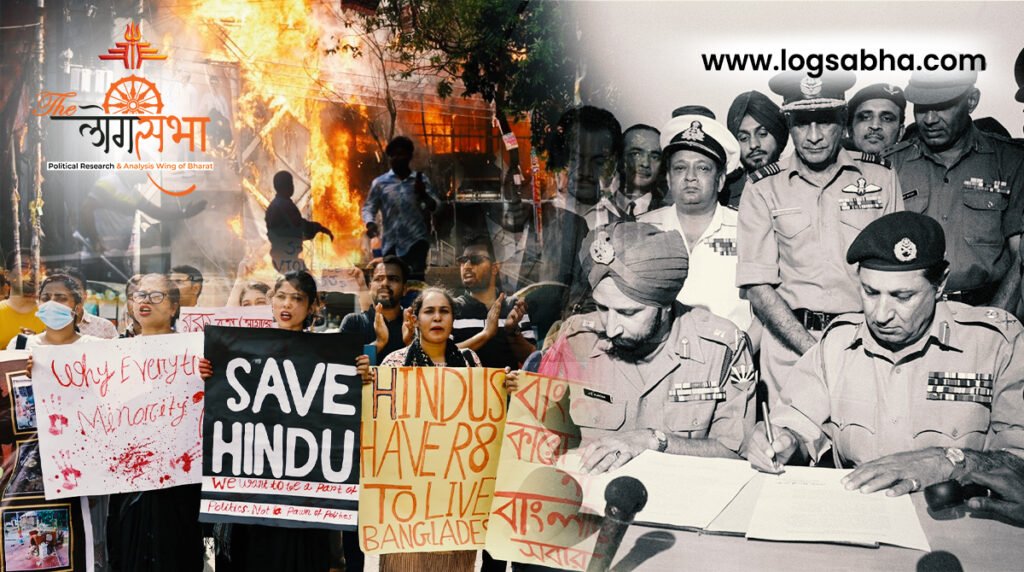
Bangladesh’s current posture rests on three deeply troubling contradictions. First, it enjoys the political freedom born out of India’s 1971 intervention while steadily erasing that historical debt from its public and political discourse. Second, it permits the rise of anti-India narratives and communal violence particularly against Hindus while portraying India as a convenient external adversary rather than a foundational ally. Third, and most disturbingly, the Indian government’s response has been marked more by diplomatic caution than moral clarity. When a neighbour forgets who stood beside it at its birth, and the benefactor chooses restraint over responsibility, history is not just ignored it is actively undermined.
What is unfolding is not a bilateral misunderstanding, but a test of whether truth, accountability, and human suffering still matter in regional politics.
The Bangladesh Liberation War of 1971: From Systemic Injustice to Nationhood
The Bangladesh Liberation War of 1971 remains one of the most consequential and traumatic conflicts in South Asian history. Fought between 26 March and 16 December, it brought an end to Pakistan’s flawed two-wing political experiment and resulted in the emergence of Bangladesh as a sovereign state. The conflict was not a simple struggle for secession; it was simultaneously a civil war, a campaign of mass violence bordering on genocide, and an international confrontation shaped by Cold War rivalries.
Decades of political exclusion, economic extraction, and cultural repression laid the groundwork for the crisis. When these structural injustices were met with military brutality, the outcome was inevitable: mass atrocities, the displacement of millions, and a humanitarian disaster of historic proportions. India’s intervention ultimately tipped the balance, but the war’s legacy continues to provoke debate over accountability, international complicity, and the moral failures of global powers.
Structural Roots: A State Divided at Birth
The origins of the 1971 conflict can be traced directly to the 1947 Partition of British India. Pakistan emerged as a geographically fragmented nation, with East and West Pakistan separated by more than 1,600 kilometres of Indian territory and connected only by a shared religious identity. This fragile arrangement ignored deep linguistic, cultural, and economic differences.
Although East Pakistan accounted for roughly 55 percent of Pakistan’s population, it was systematically marginalised. Between 1950 and 1970, it received just over 40 percent of national budgetary allocations, while political authority, military leadership, and industrial investment remained overwhelmingly concentrated in the western wing. Bengali participation in the armed forces and civil services was minimal; by the mid-1960s, Bengalis constituted only about five percent of military officers.
Cultural repression compounded these inequalities. In 1948, Urdu was declared the sole national language despite Bengali being spoken by the majority of Pakistanis. This decision triggered the Language Movement, culminating in the killing of student demonstrators on 21 February 1952. The episode became a defining moment in Bengali resistance and is now commemorated worldwide as International Mother Language Day.
Over time, the ideological divide widened. While West Pakistan promoted a vision of Islamic unity under centralised authority, Bengali political consciousness increasingly emphasised linguistic pride, cultural autonomy, and secular governance.
The breaking point came in 1970. The Bhola cyclone devastated East Pakistan, killing up to half a million people. The central government’s delayed and inadequate response was widely perceived as indifference. Later that year, Sheikh Mujibur Rahman’s Awami League won a sweeping mandate in Pakistan’s first general elections, securing 167 of 169 seats in East Pakistan enough to form the national government. The refusal of West Pakistani leaders, particularly Zulfikar Ali Bhutto, to honour the electoral verdict destroyed the last vestiges of trust.
From Repression to Resistance
On the night of 25 March 1971, the Pakistani military launched Operation Searchlight, a brutal campaign designed to eliminate Bengali political opposition. Universities, student dormitories, media houses, and residential neighbourhoods were attacked. Intellectuals, political activists, and Hindu minorities were deliberately targeted. Mass executions, widespread sexual violence, and systematic village destruction followed.
In the early hours of 26 March, Sheikh Mujibur Rahman declared Bangladesh’s independence before being arrested. The declaration was subsequently broadcast by Major Ziaur Rahman, signalling the formal beginning of the liberation struggle.
A provisional government was established on 17 April 1971, with Tajuddin Ahmad as prime minister. Armed resistance took shape under the Mukti Bahini, comprising Bengali defectors from the Pakistani military and civilian volunteers. Under the leadership of M. A. G. Osmani, guerrilla warfare spread across the countryside, disrupting supply lines and undermining Pakistani control.
War Expands: Regional and Global Dimensions
From April to November 1971, the conflict remained largely a guerrilla war. Operations such as Operation Jackpot in August inflicted severe damage on Pakistani naval assets. Meanwhile, violence and repression triggered a massive humanitarian crisis. Nearly ten million refugees fled to India, overwhelming border regions and creating immense economic and political pressure on New Delhi.
On 3 December 1971, Pakistan launched pre-emptive air strikes against Indian airbases, transforming the conflict into a full-scale Indo-Pakistani war. India responded decisively. Under Prime Minister Indira Gandhi and Army Chief Sam Manekshaw, Indian forces achieved rapid air and naval dominance and advanced swiftly across East Pakistan.
Within less than two weeks, Pakistani resistance collapsed. On 16 December 1971, Lieutenant General A. A. K. Niazi surrendered to Indian Lieutenant General Jagjit Singh Aurora in Dhaka. Around 93,000 Pakistani soldiers were taken prisoner—the largest military surrender since the Second World War.
Atrocities and Human Cost
The human cost of the war was immense. Estimates of civilian deaths range from 300,000 to 3 million, with Hindus and intellectuals disproportionately targeted. Between 200,000 and 400,000 women were subjected to systematic sexual violence. In December 1971, Pakistani forces and their collaborators intensified killings of academics, journalists, doctors, and artists in a final attempt to cripple the emerging nation.
U.S. diplomatic communications, including the infamous Blood Telegram, described the violence as “selective genocide.” Yet strategic considerations prevailed. The United States, under President Richard Nixon and Secretary of State Henry Kissinger, continued to support Pakistan as part of its Cold War alignment with China. In contrast, the Soviet Union backed India diplomatically and militarily, countering U.S. pressure at the United Nations.
Outcomes and Enduring Legacy
The war culminated in the creation of Bangladesh as an independent republic and permanently reshaped South Asia’s strategic balance. Pakistan was severely weakened, while India emerged as the dominant regional power. The Simla Agreement of 1972 normalised relations between India and Pakistan and enabled the return of prisoners of war.
Bhutan was the first country to recognise Bangladesh, followed by broad international recognition within a year. Yet unresolved questions persist regarding genocide recognition, accountability for war crimes, and the international community’s failure to act decisively.
For Bangladesh, the war forged a national identity grounded in language, culture, and secular values rather than religious nationalism. Globally, it remains a sobering illustration of how political exclusion and military repression can lead to catastrophic human consequences.
The Bangladesh Liberation War was a profound assertion of self-determination achieved at extraordinary human cost. It dismantled an unjust political order, exposed the moral limits of Cold War diplomacy, and fundamentally altered South Asia’s geopolitical landscape.
More than fifty years later, the war endures not only in monuments and memory but as a cautionary lesson: when democracy is denied, culture suppressed, and power enforced through violence, the consequences extend far beyond politics they scar humanity itself.
India and the Birth of Bangladesh: Intervention, Imperatives, and Historical Consequence
India’s role in the creation of Bangladesh in 1971 was decisive, multi-layered, and historically transformative. Through humanitarian relief, sustained diplomatic engagement, military training, and direct armed intervention, India converted East Pakistan’s struggle for autonomy into a successful war of liberation. The conflict culminated on 16 December 1971 with the Pakistani Army’s surrender in Dhaka and the emergence of Bangladesh as an independent state.
Although the origins of the war lay in Pakistan’s internal contradictions, India’s involvement internationalised the crisis, placing it firmly within the geopolitical currents of the Cold War. To its supporters, India’s intervention represents a rare instance of morally grounded state action in international politics. To critics, it reflected calculated strategic interests. Both interpretations are valid and together explain why 1971 remains one of the most consequential moments in South Asian history.
Background: A Crisis Rooted in Partition and Marginalisation
The foundations of Bangladesh’s liberation struggle were laid at the moment of Pakistan’s creation in 1947. Pakistan emerged as a geographically fractured state, with its eastern and western wings separated by more than 1,600 kilometres of Indian territory and bound primarily by religion rather than language, culture, or economic integration.
Despite constituting nearly 55 percent of Pakistan’s population, East Pakistan remained systematically marginalised. Between 1950 and 1970, it received only about 40 percent of national budgetary allocations, while political authority, industrial growth, and military power were concentrated in the western wing. Bengali representation in the armed forces and civil administration was negligible by the mid-1960s, Bengalis accounted for barely five percent of military officers.
Cultural repression compounded these grievances. The imposition of Urdu as Pakistan’s sole national language in 1948 ignited the Language Movement, which reached a tragic climax in 1952 when student protesters were killed by state forces. Over time, economic injustice merged with linguistic and political demands, giving rise to a powerful Bengali nationalist consciousness.
The final rupture came in 1970. The Bhola cyclone devastated East Pakistan, killing up to half a million people. The central government’s slow and inadequate response reinforced perceptions of deliberate neglect. Later that year, Sheikh Mujibur Rahman’s Awami League secured a sweeping electoral mandate, winning 167 of 169 seats in East Pakistan enough to govern Pakistan as a whole. The refusal of West Pakistani leaders, particularly Zulfikar Ali Bhutto, to transfer power shattered any remaining legitimacy of the Pakistani state in the east.
On the night of 25 March 1971, the Pakistani military launched Operation Searchlight, a brutal campaign involving mass executions, systematic sexual violence, and targeted killings of intellectuals and Hindu minorities. Civilian deaths are estimated to range between 300,000 and 3 million, with 200,000 to 400,000 women subjected to rape. Nearly ten million refugees fled into India, triggering one of the largest humanitarian crises of the twentieth century.
India’s Diplomatic Strategy: Internationalising a Moral Emergency
Under Prime Minister Indira Gandhi, India framed the unfolding violence not as an internal Pakistani matter but as a humanitarian catastrophe with regional and global implications. New Delhi consistently highlighted the scale of atrocities and the refugee crisis in international forums, positioning its actions as morally compelled rather than territorially motivated.
A critical diplomatic milestone was the Indo-Soviet Treaty of Peace, Friendship and Cooperation signed in August 1971. This agreement provided India with strategic protection against potential intervention by the United States or China both of which supported Pakistan during the Cold War. Soviet vetoes at the United Nations blocked resolutions that might have constrained Indian action.
India formally recognised Bangladesh on 6 December 1971, even before the war concluded, granting political legitimacy to the liberation struggle. Declassified U.S. documents, including the “Blood Telegram” sent by American diplomats in Dhaka, later revealed deep internal dissent within the U.S. administration over its support for Pakistan and underscored India’s moral positioning.
Humanitarian Responsibility: Refugees and Relief
India bore the overwhelming burden of the humanitarian fallout. Nearly ten million refugees crossed into Indian territory, inundating border states such as West Bengal, Tripura, Assam, and Meghalaya. The Indian government established extensive refugee camps, providing food, shelter, healthcare, and education at enormous economic cost estimated at over $500 million at the time.
This unprecedented influx placed severe strain on India’s economy and infrastructure. It also reinforced India’s argument that the crisis had transcended Pakistan’s sovereignty and become a regional emergency demanding decisive intervention.
Military and Logistical Support: From Resistance to Decisive Victory
Even before open war began, India provided extensive covert and overt support to the Bangladeshi resistance. From April 1971 onwards, Indian forces trained, armed, and equipped approximately 175,000 Mukti Bahini fighters along the border. Indian intelligence agencies coordinated sabotage operations, including Operation Jackpot, which significantly crippled Pakistani naval capabilities.
The conflict escalated into full-scale war on 3 December 1971 when Pakistan launched pre-emptive air strikes on Indian airfields. India responded with decisive military action. Under the leadership of Army Chief Sam Manekshaw, Indian forces numbering roughly 250,000 achieved rapid air and naval supremacy and advanced swiftly on multiple fronts in East Pakistan.
Within thirteen days, Pakistani resistance collapsed. On 16 December 1971, Lieutenant General A. A. K. Niazi surrendered unconditionally to Indian Lieutenant General Jagjit Singh Aurora in Dhaka. Approximately 93,000 Pakistani soldiers were taken prisoner, marking the largest military surrender since the Second World War.
Outcomes and Strategic Aftermath
Bangladesh emerged as an independent nation, while India consciously refrained from annexation or political domination. Through the Simla Agreement of 1972, India returned prisoners of war and captured territory, reinforcing its claim that the intervention was not an act of conquest.
The war decisively weakened Pakistan and reshaped the balance of power in South Asia, establishing India as the region’s dominant military force. However, it also strained India’s relations with the United States, whose leadership under President Richard Nixon had openly tilted toward Pakistan.
Casualties were substantial: approximately 3,900 Indian soldiers were killed, alongside tens of thousands of Bangladeshi fighters and civilians. Pakistan suffered heavy military losses and long-term political destabilisation.
Assessment: Moral Imperative or Strategic Calculation?
India’s intervention was driven by overlapping imperatives. The refugee crisis created an undeniable humanitarian obligation, while strategic considerations weakening Pakistan, securing eastern borders, and countering U.S.–China alignment shaped policy decisions.
Critics argue that India exploited the crisis to permanently alter Pakistan’s territorial integrity. Supporters counter that India demonstrated restraint after victory, respecting Bangladesh’s sovereignty and avoiding annexation.
Both perspectives contain elements of truth. India’s actions were neither purely altruistic nor purely opportunistic they represented a convergence of moral responsibility and national interest.
Conclusion
India’s role in Bangladesh’s independence was decisive and irreversible. Without Indian diplomatic backing, humanitarian assistance, military training, and direct intervention, the liberation of Bangladesh would likely have been far longer and far more catastrophic.
The events of 1971 stand as a rare moment when moral outrage, humanitarian necessity, and strategic calculation aligned to reshape history. They also serve as a stark reminder: when state repression descends into genocide, neutrality becomes complicity and intervention, however imperfect, can change the destiny of millions.
A Pattern of Crisis in Bangladesh and the Reemergence of the Anti-India Narrative
An article published by The Quint on December 22, 2025, examines what it describes as a recurring cycle of political instability in Bangladesh following the formation of the interim administration under Muhammad Yunus in August 2024. The central argument is that episodes of internal disorder marked by protests, governance breakdowns, and minority insecurity are increasingly accompanied by an escalation in anti-India rhetoric, a cooling of bilateral relations, and a noticeable recalibration of Dhaka’s foreign policy, including cautious overtures toward Pakistan.
Rather than treating these developments as isolated diplomatic frictions, the article situates them within a broader political and geopolitical shift. It suggests that external posturing has become intertwined with internal fragility, with implications that extend well beyond Bangladesh’s borders.
Key Developments and Arguments Identified in the Article
1. Confrontational Rhetoric and Diplomatic Strain
Since assuming office, the Yunus-led interim government has, according to the article, adopted a more adversarial tone toward India. This includes summoning India’s High Commissioner during periods of unrest and allowing political discourse that frames India less as a longstanding partner and more as a convenient antagonist.
The article contrasts this sharply with the tenure of Sheikh Hasina, whose government prioritised close strategic, economic, and security cooperation with New Delhi. In contrast, the interim administration is portrayed as signalling openness to renewed engagement with Pakistan, including cultural exchanges and contacts involving Pakistani military-linked figures—moves laden with symbolism given the unresolved historical memory of 1971.
2. India’s Northeast, China, and Strategic Signalling
A significant point of contention highlighted in the article is Yunus’s March 2025 visit to China, during which he described India’s northeastern “Seven Sister” states as geographically constrained and suggested Bangladesh as their primary maritime gateway. The article interprets these remarks as more than rhetorical flourish, arguing that they implicitly encouraged expanded Chinese economic and strategic presence in a region India considers highly sensitive.
At the April 2025 BIMSTEC summit in Bangkok, Indian Prime Minister Narendra Modi responded obliquely by raising concerns over the safety of minorities in Bangladesh and cautioning against rhetoric that could destabilize the regional environment. This exchange, the article notes, reflected a growing erosion of mutual confidence.
3. Release of Extremist Figures and Security Concerns
The article also draws attention to the release of individuals associated with extremist organisations after August 2024, particularly Mufti Jashimuddin Rahmani, leader of the Al-Qaeda-inspired Ansarullah Bangla Team (ABT). Rahmani, previously convicted for the 2013 murder of blogger Ahmed Rajib Haider, reportedly issued inflammatory statements targeting India following the custodial death of youth leader Sharif Osman Hadi.
Subsequent arrests by Indian security agencies, especially in Assam, of individuals allegedly linked to ABT and found with weapons are presented as reinforcing concerns that militant networks may be exploiting Bangladesh’s political turbulence. These developments, the article argues, have heightened anxieties in New Delhi about cross-border security vulnerabilities.
4. Shifting Blame for Internal Failures
A recurring theme in the article is the interim government’s alleged tendency to externalise responsibility for domestic crises. Following Hadi’s death in custody, Bangladeshi authorities publicly suggested that suspects had escaped into India, a claim later diluted when investigators acknowledged the absence of evidence supporting cross-border movement. India formally rejected the accusation, reiterating its long-standing position that it does not permit its territory to be used for activities hostile to Bangladesh.
The article contends that such narratives serve a political function: redirecting public frustration away from governance shortcomings and toward an external actor.
5. Protests, Institutional Stress, and Minority Insecurity
The foreign policy shift is placed within a broader landscape of domestic instability. Protests by groups such as “July Oikya” disrupted administrative functioning and forced the temporary closure of Indian visa centres in several Bangladeshi cities due to security threats. Although Bangladesh’s foreign affairs adviser later clarified that extremist slogans raised during protests did not reflect official policy, the reputational impact had already taken hold.
The Bangladesh Nationalist Party is cited as criticising the interim administration for failing to maintain law and order. Its Secretary General, Mirza Fakhrul Islam Alamgir, publicly attributed the deteriorating security situation to government inaction, even as the party sought to distance itself from overtly anti-India Islamist elements.
Historical and Geopolitical Context
The article frames current developments against Bangladesh’s post-1971 history, underscoring India’s decisive role in the country’s liberation. Against this backdrop, any perceived distancing from India in favour of Pakistan is portrayed not merely as pragmatic diplomacy but as a symbolic departure from historical alignment.
Simultaneously, the article links Dhaka’s evolving posture to China’s expanding footprint in South Asia through infrastructure financing and strategic connectivity projects. Yunus’s remarks on India’s northeast are interpreted as aligning with broader Chinese regional ambitions, raising concerns in New Delhi about strategic encirclement.
Analytical Assessment: Themes, Implications, and Dissenting Views
Central Themes:
The article identifies a recurring pattern in which domestic crises coincide with heightened anti-India rhetoric, the marginalisation or scapegoating of minorities particularly Hindus perceived as aligned with India, and foreign policy signals that suggest strategic distancing from New Delhi.
Regional Implications:
If sustained, this trajectory could strain border management, intelligence cooperation, and trade relations, which have exceeded $12 billion in recent years. The combination of renewed engagement with Pakistan and the release of extremist figures also raises concerns about the reactivation of transnational militant networks.
Critical Perspectives:
Some analysts caution that the article may overinterpret intent, noting that Yunus’s government remains broadly pro-Western rather than explicitly pro-Pakistan. Others observe that Indian media often foregrounds minority persecution and security risks, while Bangladeshi narratives emphasise sovereignty and post-Hasina political recalibration.
Conclusion
The article portrays Muhammad Yunus’s interim administration as presiding over a period of pronounced political fragility, social unrest, and an increasingly strained relationship with India. Whether this reflects a deliberate strategic pivot or an improvised response to governance challenges remains open to debate.
What is unmistakable, however, is that the repeated invocation of anti-India narratives during moments of domestic stress risks deepening mistrust, emboldening extremist actors, and destabilising an already volatile regional order. In South Asia’s contested political landscape, internal failures often seek external explanations, and history suggests that the consequences of such dynamics rarely remain confined within national borders.
Leadership, Liberation, and a Contested Legacy
Sheikh Mujibur Rahman (17 March 1920 – 15 August 1975), revered as Bangabandhu, the Friend of Bengal, stands at the centre of Bangladesh’s political birth. Celebrated as the Father of the Nation, Mujib devoted his life to securing Bengali political rights, cultural dignity, and self-determination. His guiding worldview, often described as Mujibism, wove together nationalism, secularism, and social justice, forming the ideological bedrock of the new state.
Yet his legacy is neither simple nor uncontested. While his leadership was indispensable in ending Pakistan’s domination of East Bengal, his years in power after independence remain the subject of intense debate. Admirers see a nation-builder confronting impossible odds; critics point to economic mismanagement, political centralisation, and an authoritarian turn. Mujib’s story is thus one of historic liberation shadowed by unresolved contradictions.
Early Life and Formative Influences
Born in Tungipara in present-day Gopalganj, Mujib grew up in a household shaped by public service and rural realities. His father’s role as a local official instilled civic responsibility, while life in the Bengal countryside exposed him early to poverty, inequality, and famine. Known in childhood as Khoka, Mujib displayed a natural empathy and leadership that later became hallmarks of his political style.
His education, interrupted by illness but completed in Calcutta, coincided with a growing political awakening. Initially aligned with the Muslim League during the final years of British rule, Mujib gradually moved away from communal politics toward an inclusive, Bengali-centred nationalism. His marriage to Fazilatunnesa Mujib (Bangamata) provided enduring personal and political support through years of imprisonment and struggle.
Mujib’s political ascent unfolded amid Pakistan’s deep internal imbalance after Partition. As a co-founder of the Awami League in 1949, he became a leading voice against linguistic repression and economic exploitation in East Pakistan. His involvement in the 1952 Language Movement opposing the imposition of Urdu as the sole national language cemented his role as a defender of Bengali identity.
Repeated arrests, amounting to more than a decade in prison, only strengthened his popular appeal. By the mid-1960s, Mujib articulated the Six-Point Programme, demanding near-complete autonomy for East Pakistan. This platform transformed him from a regional politician into the embodiment of Bengali aspirations. His arrest in the Agartala Conspiracy Case and release amid mass protests elevated him to a near-mythic status.
The Awami League’s landslide victory in Pakistan’s 1970 general election gave Mujib a democratic mandate to govern the entire country. The refusal of West Pakistani elites to honour that mandate marked the final rupture.
The Road to Independence
Mujib’s historic 7 March 1971 speech electrified a population on the edge of rebellion, calling for sustained resistance while stopping short of an explicit declaration of independence. After the Pakistani military launched a brutal crackdown later that month, Mujib formally proclaimed Bangladesh’s independence and was immediately arrested.
Though imprisoned in West Pakistan during the Liberation War, Mujib remained the symbolic centre of the struggle. The Mukti Bahini’s resistance, supported decisively by India, culminated in Pakistan’s surrender on 16 December 1971. Mujib returned to a liberated homeland as its undisputed leader.
Governing a New Nation: Vision and Constraints
As president and later prime minister, Mujib faced the immense challenge of rebuilding a country devastated by war. His government adopted the 1972 Constitution, anchored in secularism, nationalism, democracy, and socialism. Key industries were nationalised, land reforms initiated, and Bangladesh rapidly sought international recognition.
His foreign policy, captured in the phrase “friendship to all, malice to none,” aimed to balance Cold War rivalries while asserting cultural sovereignty. His address to the United Nations in Bengali symbolised this assertion on the world stage.
Governance, however, proved far more difficult than liberation. Economic disruption, weak institutions, corruption, and natural disasters most notably the 1974 famine eroded public confidence. In response, Mujib increasingly centralised authority, creating the Jatiya Rakkhi Bahini and, in 1975, instituting a one-party system under BAKSAL. Intended to impose order, these measures narrowed political space and intensified dissent.
Assassination and Aftermath
On 15 August 1975, Mujib and most of his family were assassinated in a military coup, abruptly ending his rule and plunging Bangladesh into prolonged instability. Only his daughters Sheikh Hasina and Sheikh Rehana survived, as they were abroad at the time.
The assassination shattered the moral authority of the state and marked a decisive break from Mujib’s secular-nationalist vision. Subsequent governments alternated between repudiation and rehabilitation of his legacy, reflecting Bangladesh’s enduring ideological divisions.
Legacy: Founder, Visionary, and Cautionary Figure
Sheikh Mujibur Rahman remains Bangladesh’s defining historical figure. He is venerated for leading a people out of political subjugation and restoring pride rooted in language and culture. His speeches, writings, and symbolism continue to shape national consciousness.
At the same time, his record as a ruler invites sustained scrutiny. The authoritarian turn of his final years highlights the dangers that arise when revolutionary legitimacy hardens into unchecked power. Mujib’s life thus embodies both the promise of liberation and the perils of governance in a fragile postcolonial state.
In historical judgment, Mujib is neither an unblemished hero nor a failed autocrat alone. He was a leader forged by oppression, elevated by mass hope, and constrained by the immense burdens of nation-building. His enduring relevance lies in that complexity and in Bangladesh’s continuing struggle to reconcile freedom with democracy.
“India Sees the Chaos”: Sheikh Hasina on Yunus’s Bangladesh — A Refined Analysis
An interview published by The Times of India on 22 December 2025 features former Bangladeshi prime minister Sheikh Hasina delivering a forceful critique of Bangladesh’s political trajectory since her removal from office in August 2024. Speaking from exile, Hasina accuses the interim administration headed by Muhammad Yunus of presiding over a collapse of governance, failing to protect minorities, and allowing the country to descend into a state of disorder that is now evident beyond its borders, most notably to India.
Framed around recent episodes of violence and unrest, the interview advances Hasina’s central claim: Bangladesh is no longer experiencing isolated breakdowns of law and order, but a sustained pattern of institutional failure under an unelected and ineffective interim regime.
Core Assertions in the Interview
At the heart of Hasina’s critique is the contention that the Yunus-led administration lacks both democratic legitimacy and governing capacity. She argues that since her ouster, state authority has steadily eroded, enabling extremist groups, weakening law enforcement, and leaving minorities particularly Hindus acutely vulnerable. In her account, the interim government is simultaneously unable to govern and yet actively reshaping Bangladesh’s domestic and foreign policy without a popular mandate.
To substantiate this argument, Hasina points to two recent incidents that she presents as emblematic of a deeper structural breakdown.
Incidents Cited as Evidence of Systemic Failure
1. The Death of Sharif Osman Hadi
Hadi, a 25-year-old youth leader associated with the 2024 uprising, was shot in Dhaka on 12 December 2025 and succumbed to his injuries six days later in Singapore after prolonged treatment. His death triggered violent protests in the capital, during which mobs attacked media organisations and public institutions. Hasina argues that the state’s inability to prevent both the shooting and the subsequent unrest exposed a profound collapse in policing, accountability, and political control.
2. The Lynching of Dipu Chandra Das
Hasina also highlights the lynching of Dipu Chandra Das, a 27-year-old Hindu man in Mymensingh, who was reportedly beaten, tied to a tree, and set on fire by a mob following blasphemy allegations. While arrests were eventually made, Hasina insists that reactive law enforcement cannot compensate for a state that fails to deter communal violence or guarantee minority safety. She situates the incident within what she describes as a broader surge in anti-minority attacks since August 2024.
Broader Accusations Against the Interim Administration
Beyond individual cases, Hasina levels sweeping charges against the Yunus government:
- Governance Breakdown: She describes the interim administration as effectively powerless, unable to maintain public order, prevent mob violence, or ensure basic citizen security.
- Radicalisation and Extremism: Hasina alleges that extremist elements have been released, rehabilitated, or tolerated, fostering an atmosphere of intimidation and ideological hardening.
- Minority Insecurity: She claims attacks on Hindus and other minorities have risen sharply, accusing the state of moral indifference and administrative paralysis.
- Foreign Policy Drift: Hasina criticises what she calls an unmandated reorientation of Bangladesh’s foreign relations, marked by hostility toward India and overtures to Pakistan and China, undertaken without electoral legitimacy or public consent.
Timeline of Key Developments
- August 2024: Sheikh Hasina is removed from office following the “July uprising”; Muhammad Yunus assumes leadership as Chief Adviser of an interim government.
- 12 December 2025: Sharif Osman Hadi is shot in Dhaka.
- 18 December 2025: Hadi dies in Singapore.
- 20 December 2025: Dipu Chandra Das is lynched in Mymensingh.
- 22 December 2025: Hasina’s interview is published, explicitly linking these events to systemic governance failure.
Political and Geopolitical Context
Hasina’s remarks are rooted in Bangladesh’s post-1971 history, in which India played a decisive role in the country’s liberation and remained its closest strategic partner for decades. Her criticism of rising anti-India rhetoric under Yunus reflects concern over what she perceives as a deliberate rupture with that historical legacy.
She also alludes to Bangladesh’s expanding engagement with China and renewed contact with Pakistan, developments that stand in sharp contrast to her own pro-India, secular-nationalist orientation. Domestically, these shifts coincide with reports of widespread unrest, economic stress, and more than two thousand incidents of minority-targeted violence since her removal.
Significance and Competing Interpretations
Why the Interview Resonates
Hasina’s intervention underscores the fragility of Bangladesh’s post-uprising order. By linking lawlessness, minority persecution, and diplomatic reorientation, she frames the interim government’s failures as interconnected rather than accidental. Her argument implies that domestic instability is now spilling into regional relations, with India increasingly unsettled by developments across its eastern border.
Points of Contention
Supporters of Yunus dismiss Hasina’s claims as politically motivated, arguing that she is deflecting scrutiny from her own record of centralisation and repression while in power. They portray current turmoil as the unavoidable turbulence of political transition. Critics of the interim government, however, view Hasina’s allegations as broadly consistent with independent reporting on rising violence, weakened institutions, and extremist resurgence.
Conclusion
Sheikh Hasina’s interview presents a bleak portrait of Bangladesh under interim rule: a state struggling to enforce law, protect minorities, and articulate a coherent national direction.
Regardless of one’s assessment of her motives, the incidents she cites raise fundamental questions about governance without mandate, authority without accountability, and stability without institutions.
What emerges most clearly is that Bangladesh’s internal crisis is no longer purely domestic. As Hasina bluntly puts it, “India sees the chaos.” In a region as tightly interconnected and politically volatile as South Asia, such chaos rarely remains contained within national borders.
The Modi Government and Hindu Suffering in Bangladesh: Silence by Design, Not Absence of Knowledge
The charge that the Modi government is “not saying anything” about the suffering of Hindus in Bangladesh does not stem from ignorance or lack of information. It stems from something more deliberate: strategic restraint bordering on political silence. While New Delhi is fully aware of the scale and severity of violence against Hindus in Bangladesh since August 2024, its public posture has remained measured, cautious, and conspicuously understated—especially when contrasted with the gravity of events on the ground.
This is not a case of the Indian state being unaware. It is a case of the Indian state choosing not to speak loudly enough, not to act forcefully enough, and not to elevate the issue to the moral and diplomatic urgency it warrants.
What the Modi Government Has Not Done
Despite repeated incidents of mob violence, lynchings, temple vandalism, and forced displacement of Hindus in Bangladesh, the Modi government has avoided:
-
A formal, high-decibel condemnation by the Prime Minister specifically naming Hindu persecution in Bangladesh
-
Any extraordinary diplomatic measure (such as recall of envoys, sanctions, or international escalation)
-
A sustained global campaign comparable to India’s advocacy on issues like Ukraine, terrorism, or the Middle East
-
A clear red line communicated to Dhaka linking minority protection to bilateral cooperation
The absence of these actions has created a powerful perception domestically and internationally—that India’s response is hesitant at best.
Token Statements vs Political Leadership
Yes, there have been statements.
The Ministry of External Affairs, under S. Jaishankar, has issued routine expressions of “concern.” Diplomatic channels have been used. The language has been cautious, procedural, and carefully de-escalatory.
But there is a fundamental difference between bureaucratic acknowledgment and political leadership.
Notably absent has been a sustained, unequivocal intervention by Narendra Modi himself—someone who otherwise does not hesitate to speak on global moral issues. The Prime Minister’s silence in his own voice, especially on repeated lynchings and large-scale communal targeting, has been glaring.
In Indian politics, what the Prime Minister does not say is often more consequential than what ministries quietly note.
Why the Silence Persists
The restraint appears to be driven by three overlapping calculations:
1. Geopolitical Caution
Bangladesh is a critical neighbour. Trade, border stability, and regional security are at stake. With Dhaka under Muhammad Yunus drifting closer to China and reopening channels with Pakistan, New Delhi is wary of pushing it further away.
2. Diplomatic Orthodoxy
India’s foreign policy establishment traditionally avoids framing minority persecution abroad in overtly religious terms, fearing accusations of interference or hypocrisy. This has led to language so neutral that it borders on evasive.
3. Selective Moral Outrage
The Modi government has shown willingness to speak forcefully on Hindu issues within India and on global issues aligned with strategic interests. The contrast with its subdued response to Hindu suffering outside India—especially next door—is impossible to ignore.
Why This Silence Matters
The consequences of restraint are not abstract.
For Bangladeshi Hindus, it signals abandonment by the one country they historically associate with protection and solidarity.
For radical elements in Bangladesh, it lowers the cost of violence by reducing international pressure.
For India’s moral standing, it creates a contradiction between domestic rhetoric and external action.
When lynchings, arson, and forced displacement fail to elicit strong words, perpetrators learn a dangerous lesson: there will be no serious consequences.
The Gap Between Power and Responsibility
India is not a helpless observer. It is Bangladesh’s largest neighbour, a key economic partner, and a regional power with diplomatic leverage. Silence or carefully worded understatement under such circumstances is not neutrality. It is a choice.
History rarely judges governments by what they knew.
It judges them by what they said, did, or refused to do when injustice was visible.
Conclusion
The Modi government’s response to Hindu suffering in Bangladesh is not one of ignorance, nor even of complete inaction. It is something more troubling: a conscious decision to underplay, under-speak, and under-lead.
In a region shaped by history, memory, and moral obligation, such restraint carries a cost. When persecution is met with politeness, when lynchings are answered with procedural language, and when silence replaces solidarity, the message travels far beyond diplomacy.
And for those on the receiving end of violence, that message is painfully clear: they are seen, but they are not being stood up for.
Bangladesh today stands at a moral crossroads, and India at a diplomatic one. A nation born with India’s blood, resources, and resolve now looks away from that history, while minorities are persecuted and hostility is normalised. At the same time, New Delhi’s restrained response projects hesitation where moral clarity is required. Strategic patience cannot justify silence when human suffering is visible and historical truth is being erased. Gratitude cannot be demanded, but truth must be defended. If Bangladesh continues to repudiate the hand that helped birth it, and if India continues to mute its voice in the face of injustice, both risk forfeiting credibility—one with its past, the other with its principles. History remembers those who act when conscience demands it, not those who calculate comfort over responsibility.