
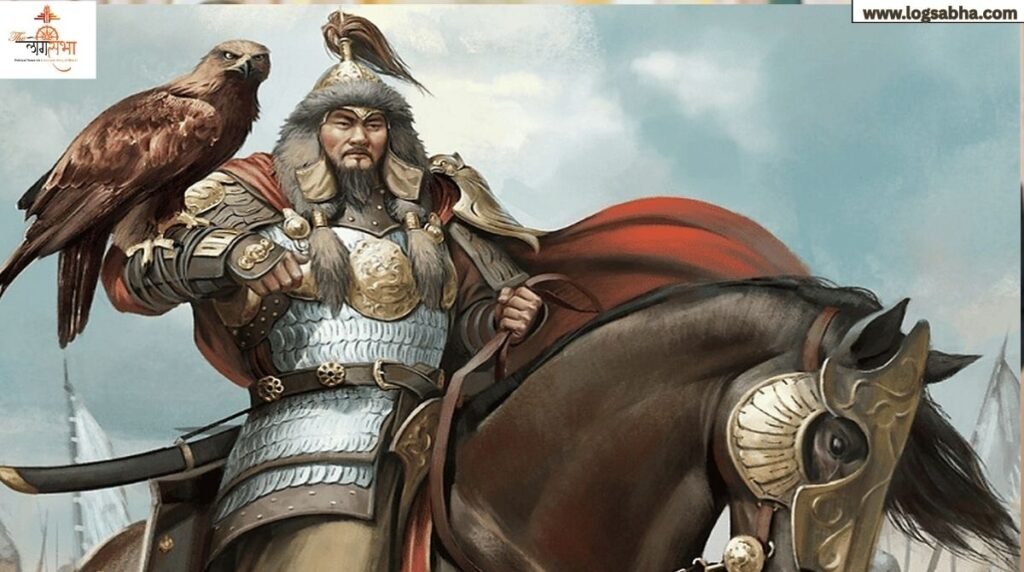
From a hunted orphan to the most feared name in human history this is the life of Genghis Khan.
Introduction
Genghis Khan (born Temüjin, c. 1162–1227 CE) was one of the most consequential figures in global history. Emerging from the harsh nomadic world of the Mongolian steppe, he unified fractured tribes into a single political and military entity and founded the Mongol Empire, the largest contiguous land empire ever recorded. His career reshaped Eurasia through conquest, governance, and unprecedented intercontinental connectivity, while also leaving behind a legacy of immense violence and disruption.
Early Life and Ascent
Temüjin was born near the Onon River into the Borjigin clan. His early life was defined by instability and survival. Following the poisoning of his father, Yesügei, his family was abandoned by their tribe and forced into poverty. Temüjin experienced hunger, enslavement, and betrayal conditions that forged his pragmatic and uncompromising leadership style.
Through strategic alliances, personal resilience, and the rejection of hereditary privilege, Temüjin gradually attracted followers. His leadership emphasized loyalty and ability rather than lineage. By the early 13th century, he had subdued rival Mongol clans. In 1206 CE, a tribal assembly (kurultai) proclaimed him Genghis Khan, marking the formal creation of the Mongol state.
Governance and Military Innovation
Genghis Khan’s success rested not only on conquest but on institutional reform:
-
Merit-based leadership, replacing aristocratic hierarchy
-
The Yassa, a legal framework enforcing unity, discipline, and order
-
Religious tolerance, protecting diverse faiths across the empire
-
Advanced communication networks, enabling rapid coordination
These measures transformed loosely connected nomadic groups into a disciplined imperial force capable of sustained expansion.
Imperial Expansion
Between 1207 and 1225 CE, Mongol campaigns extended across much of Eurasia:
-
Northern China fell through wars against the Western Xia and Jin dynasties
-
Central Asia was devastated following the destruction of the Khwarezmian Empire
-
Mongol armies reached the Caucasus and Eastern Europe, reshaping regional power structures
Their military doctrine relied on speed, intelligence, psychological warfare, and mobility. While tactically revolutionary, these campaigns caused catastrophic civilian losses. Scholarly estimates attribute between 10 and 40 million deaths to Mongol conquests through warfare, famine, and displacement.
Genghis Khan died in 1227 CE during a campaign against the Western Xia. His burial site was deliberately concealed, contributing to the enduring mystique surrounding his death.
Legacy: Integration and Destruction
Genghis Khan’s legacy is deeply dualistic.
Constructive Contributions
-
Establishment of the Pax Mongolica, enabling secure Silk Road trade
-
Acceleration of cultural, scientific, and technological exchange
-
Promotion of meritocracy and administrative efficiency
-
Long-term geopolitical reshaping of Asia and Europe
Destructive Consequences
-
Mass killings and urban annihilation
-
Long-term demographic and economic collapse in several regions
-
Political stagnation in parts of Eastern Europe and Central Asia
Genetic studies suggest that approximately 0.5% of the world’s male population may be direct descendants of Genghis Khan, underscoring the biological as well as historical reach of his empire.
Historical Assessment
Genghis Khan represents a fundamental paradox of history: a leader whose empire connected civilizations while devastating populations on an unprecedented scale. His innovations in governance and warfare influenced statecraft for centuries, yet the human cost of his expansion remains staggering. Revered as a national founder in Mongolia, he is remembered elsewhere as both a master strategist and an agent of destruction.
Genghis Khan cannot be reduced to a singular narrative of heroism or brutality. He was both an architect of global connectivity and a catalyst for immense suffering. His life illustrates how power, when fused with vision and violence, can permanently alter the course of history leaving behind achievements that endure alongside wounds that never fully heal.
Genghis Khan and the Indian Subcontinent: A Strategic Non-Invasion
Genghis Khan (c. 1162–1227 CE), founder of the Mongol Empire, reshaped world history through an unprecedented wave of conquests across Eurasia. His armies overwhelmed vast territories stretching from northern China to Central Asia and Eastern Europe, creating the largest contiguous land empire ever known. Yet despite this momentum, the Indian subcontinent beyond the Indus frontier was never subjected to a full-scale Mongol invasion during his lifetime. This absence has long prompted historical debate. Evidence suggests that this was not a moral or ideological refusal, but a calculated strategic decision shaped by geography, logistics, and imperial priorities.
Mongols at the Edge of India
During the Mongol campaign against the Khwarezmian Empire (1219–1221 CE), Mongol forces advanced into regions that today form parts of Pakistan, including areas near the Indus Valley. These incursions, however, were limited in scope and largely incidental to the broader Central Asian campaign. After the collapse of Khwarezmian resistance, Genghis Khan chose not to extend operations deeper into the Indian heartland. Contemporary Mongol sources do not record any concrete plan to conquer India, indicating that the lack of invasion resulted from circumstance rather than deliberate ideological restraint.
Strategic Priorities and Imperial Focus
At the time, the Mongol Empire faced pressing challenges elsewhere. Ongoing campaigns against the Jin and Western Xia dynasties in China demanded immediate attention, particularly as unrest threatened the stability of newly conquered territories. Opening another major front in India would have stretched Mongol resources thin and risked weakening control over strategically vital regions. For Genghis Khan, consolidation of power was as important as expansion, and India did not present sufficient immediate strategic advantage to justify the costs of invasion.
Geography, Climate, and Logistical Constraints
Mongol military success depended heavily on fast-moving cavalry supported by large horse herds, conditions best suited to open steppe environments. Northern India presented a radically different landscape: dense population centers, cultivated plains, forests, rivers, and a hot, humid climate dominated by monsoons. Such conditions would have strained Mongol logistics, limited grazing for horses, and exposed troops to disease and exhaustion. The Indus River itself formed a natural boundary beyond which supply lines would have become increasingly vulnerable.
Political Resistance and Military Realities
Unlike many steppe polities, the Indian subcontinent was politically organised and densely populated. The Delhi Sultanate, under rulers such as Iltutmish, maintained fortified cities and large standing armies capable of sustained defense. Mongol tactics designed for mobility and open-field warfare were less effective against entrenched urban centers. The later failure of Mongol successor states to conquer India further supports the conclusion that the subcontinent posed formidable military challenges even to experienced Mongol forces.
Questioning Cultural and Religious Explanations
Popular narratives sometimes claim that Genghis Khan avoided India out of respect for its spiritual traditions or due to religious omens. Such interpretations, however, lack support in primary historical sources. Genghis Khan was known for religious tolerance but consistently subordinated belief to strategic necessity. His campaigns elsewhere demonstrate that sacred geography rarely deterred Mongol expansion when political or economic incentives were present.
Historical Perspective and Implications
Genghis Khan’s restraint parallels earlier historical precedents, such as Alexander the Great’s halt at the Indus due to logistical strain and troop fatigue. In both cases, the decision to stop advancing reflected strategic realism rather than weakness. For India, this choice meant avoiding the large-scale devastation experienced by other regions under Mongol rule, though later incursions by Mongol successors still caused significant disruption.
Conclusion
The absence of a Mongol invasion of India during Genghis Khan’s lifetime was the product of rational military judgment, not ideological hesitation. Geography, climate, political resistance, and competing imperial priorities combined to make India a high-risk, low-return objective at that moment in Mongol history. This decision highlights an often-overlooked dimension of Genghis Khan’s leadership: his ability to balance ambition with restraint. In recognizing the limits of expansion, he demonstrated that enduring empire-building depends not only on conquest, but on knowing when not to advance.
Genghis Khan Was Not Muslim: A Historical Clarification
Genghis Khan (c. 1162–1227 CE), founder of the Mongol Empire, is often mistakenly described as a Muslim ruler in popular media and online discourse. This claim is historically incorrect. Despite conquering vast regions with predominantly Muslim populations, Genghis Khan never converted to Islam. His personal belief system, political worldview, and cultural practices were firmly rooted in Tengrism, the indigenous shamanistic faith of the Mongolian steppes.
Religious Belief: Tengrism, Not Islam
Genghis Khan followed Tengrism, a spiritual tradition centered on Tengri, the eternal sky deity. This belief emphasized destiny, ancestral reverence, and harmony with nature rather than organized theology or scripture. Primary sources such as The Secret History of the Mongols record Genghis Khan performing rituals to Tengri and consulting shamans before major military decisions, underscoring his lifelong adherence to this faith.
Tengrism aligned naturally with nomadic Mongol society decentralized, pragmatic, and closely tied to the environment. Genghis Khan believed his authority as a ruler was divinely sanctioned by Tengri, reinforcing his identity as a universal sovereign rather than a religious missionary.
Origins of the Misconception
The belief that Genghis Khan was Muslim arises mainly from three factors:
Conquest of Islamic Regions
His campaigns devastated Muslim-majority states such as the Khwarezmian Empire, but these wars were political and retaliatory, not religious. The destruction followed the execution of Mongol envoys, not ideological conflict.
Conversion of Descendants
Several Mongol rulers in later generations particularly in the Golden Horde and Ilkhanate, embraced Islam. This later development is often incorrectly projected backward onto Genghis Khan himself.
Historical Conflation
Genghis Khan is frequently confused with later Muslim conquerors such as Timur (Tamerlane), further blurring distinctions in popular narratives.
Religious Tolerance as Imperial Policy
Although not Muslim, Genghis Khan enforced broad religious freedom across his empire. Under the Mongol legal code (Yassa), followers of Islam, Buddhism, Christianity, Daoism, and indigenous beliefs were permitted to practice freely. Clergy were often exempt from taxation and military service. This tolerance was strategic, aimed at maintaining stability across a vast, multicultural empire and facilitating trade and administration.
Conclusion
There is no credible historical evidence to suggest that Genghis Khan was Muslim. He remained a Tengrist throughout his life and governed an empire defined by religious pluralism rather than religious identity. Misrepresenting his beliefs oversimplifies history and obscures the pragmatic foundations of Mongol governance. Understanding Genghis Khan accurately requires separating later developments from the founder’s own life recognizing him not as a religious figure, but as a strategic ruler shaped by steppe traditions and imperial ambition.
Why the Body of Genghis Khan Has Never Been Found
The burial site of Genghis Khan (c. 1162–1227 CE), founder of the Mongol Empire, remains one of history’s greatest unresolved mysteries. Nearly eight centuries after his death, no verified tomb or remains have been discovered. This absence is not accidental; it is the result of deliberate secrecy, deep cultural beliefs, and long-standing legal and ethical restrictions designed to ensure that his grave would never be disturbed.
Death and Intentional Secrecy
Genghis Khan died in August 1227 CE during a campaign against the Western Xia kingdom in present-day China. Historical sources vary on the cause of death illness, battle wounds, or a fall from a horse but they agree on one point: his burial was carried out under extreme secrecy.
According to The Secret History of the Mongols, Genghis Khan ordered that his grave remain unmarked to prevent desecration and to ensure that his legacy would endure through his empire rather than through monuments. Later accounts describe a funeral procession that eliminated all witnesses, after which the guards themselves were killed to erase any knowledge of the burial site. Legends further claim that the landscape was deliberately altered trampled by horses or concealed by natural features to leave no trace.
Some Mongol chronicles suggest that even the coffin brought back to Mongolia may have been symbolic, containing personal belongings rather than the body itself, adding another layer of uncertainty.
Burkhan Khaldun: The Sacred Landscape
Most historians believe the burial lies near Burkhan Khaldun, a sacred mountain in Mongolia’s Khentii region. This area held profound spiritual significance for Genghis Khan and was associated with his origins, prayers, and protection. He declared it a royal sanctuary during his lifetime.
For centuries, the region was strictly protected by the Darkhad clan, guardians entrusted with safeguarding the Khan’s spirit. Today, the area remains legally protected by the Mongolian state and is off-limits to excavation, reinforcing the long-standing tradition of preservation through restraint.
Modern Searches and Ethical Limits
Despite technological advances, no confirmed tomb has been found. Modern research efforts including satellite imaging, drones, and ground-penetrating radar have identified possible burial features, but excavation is prohibited. The Mongolian government and local communities oppose invasive searches, viewing them as violations of cultural and spiritual values.
The terrain itself presents challenges: dense forests, rugged mountains, and an immense protected area make precise identification extremely difficult even with modern tools.
Historical Meaning and Legacy
The absence of Genghis Khan’s tomb reflects Mongol values that prioritized legacy through governance, law, and empire rather than physical memorials. Rooted in shamanistic beliefs, disturbing the dead was thought to endanger spiritual harmony. Unlike rulers who sought immortality through grand monuments, Genghis Khan chose anonymity in death.
Paradoxically, this secrecy has amplified his legend. The missing tomb has preserved sacred landscapes, prevented looting, and reinforced his image as a figure whose influence transcends physical remains.
Conclusion
That Genghis Khan’s body has never been found is not a historical failure it is a historical success of secrecy, belief, and intent. His hidden burial stands as a rare example of absolute concealment achieved across centuries. Until cultural, ethical, and legal boundaries change, his resting place will remain exactly as he intended: unknown, untouched, and powerful in its absence.
Key Life Events of Genghis Khan
Born as Temüjin around 1162 CE, Genghis Khan’s life is one of the most remarkable transformations in world history. From a childhood marked by betrayal and hardship, he rose to unite the Mongol tribes and establish the largest contiguous land empire ever known. The following chronology highlights the defining moments that shaped his ascent and legacy.
a. 1162 – Birth
Temüjin was born near the Onon River in present-day Mongolia to Yesügei, a minor tribal leader, and Hö’elün. His early environment was dominated by inter-tribal rivalry and instability.
b. 1171 – Death of His Father
Yesügei was poisoned by rival clans. Shortly afterward, Temüjin’s family was abandoned by their tribe, forcing them into extreme poverty and social isolation an experience that profoundly influenced his character and leadership style.
c. 1178 – Marriage to Börte
Temüjin married Börte, his childhood betrothed. Her subsequent abduction by the Merkit tribe became a turning point, pushing him to form military alliances and assert his authority through force.
c. 1184 – Escape from Captivity
Captured by the Tayichi’ud clan, Temüjin escaped through strategic ingenuity. This episode earned him loyal followers and marked the beginning of his rise as a respected leader.
1189–1206 – Unification of the Mongol Tribes
Through a combination of warfare, diplomacy, and merit-based promotion, Temüjin unified the fragmented Mongol clans. His decisive victory over rivals such as Jamukha consolidated his dominance on the steppe.
1206 – Proclaimed Genghis Khan
At a kurultai (tribal assembly), Temüjin was declared Genghis Khan, meaning “Universal Ruler.” This event marked the formal founding of the Mongol Empire and the introduction of the Yassa, a legal and administrative code.
1207–1209 – Campaign against Western Xia
Genghis Khan launched his first major external campaign, subduing the Tangut kingdom of Western Xia and signaling the beginning of imperial expansion beyond Mongolia.
1211–1215 – Invasion of the Jin Dynasty
Mongol forces invaded northern China, culminating in the capture of Yanjing (modern Beijing). This campaign demonstrated the effectiveness of Mongol military strategy against fortified states.
1219–1221 – Destruction of the Khwarezmian Empire
After Mongol envoys were executed, Genghis Khan led a devastating campaign across Central Asia, capturing major cities such as Samarkand and Bukhara and eliminating the Khwarezmian Empire.
1221–1225 – Western Expeditions
His generals Subutai and Jebe pursued fleeing enemies into the Caucasus and Eastern Europe, defeating Rus’ forces at the Battle of the Kalka River in 1223.
1226–1227 – Final Campaign and Death
Genghis Khan launched a final campaign against Western Xia. He died in August 1227 under uncertain circumstances. In accordance with Mongol tradition, he was buried in a secret, unmarked grave.
Summary
Genghis Khan’s life reflects an extraordinary rise from social marginalization to unmatched imperial authority. His ability to combine military innovation, political organization, and personal resilience reshaped Eurasian history and left a legacy that continues to influence global narratives of power and empire.
Lesser-Known Facts About Genghis Khan
1. Born With an Omen of Blood
Mongol tradition records that Temüjin was born clutching a blood clot in his fist an omen on the steppe believed to foretell a life of warfare and command. Whether symbolic or literal, the story reflects how his destiny was interpreted even at birth.
2. A Fratricide Shaped His Rise
As a teenager, Temüjin killed his half-brother Bekhter during a dispute over scarce food. In the brutal world of the steppes, this act was less about cruelty and more about survival and authority—marking his emergence as the family’s leader.
3. Enslaved, Shackled, and Unbroken
Captured by the Tayichi’ud clan, Temüjin was paraded in a wooden yoke as a slave. His daring escape hiding in river reeds became a defining moment, forging his lifelong hatred of subjugation and obsession with loyalty.
4. His Conquests Changed the Climate
The massive depopulation caused by Mongol campaigns led to widespread reforestation across Eurasia. Modern environmental studies suggest this regrowth absorbed significant carbon, creating a measurable cooling effect an unintended global consequence of conquest.
5. Religious Tolerance as State Policy
Though a follower of Tengri, Genghis Khan institutionalized religious freedom. Buddhists, Muslims, Christians, and shamans were all protected under his rule, a rare policy in a deeply sectarian medieval world.
6. Archery Perfected Into a Weapon System
Mongol warriors used thumb rings to draw powerful composite bows with speed and accuracy. Combined with cavalry mobility, this technique turned archery into a devastating, repeatable battlefield system.
7. Power Without Luxury
Despite ruling vast lands, Genghis lived simply preferring nomadic food and customs over palace life. He believed comfort weakened rulers, a philosophy that shaped both his personal life and leadership style.
8. An Unmatched Genetic Legacy
Through marriages and concubines across conquered regions, Genghis Khan left a genetic footprint unlike any other in history. Today, an estimated one in 200 men globally shares his lineage.
9. Builder of Institutions, Not Just Armies
Often dismissed as a destroyer, Genghis created enduring systems: he adopted the Uyghur script to formalize Mongolian writing and established the Yam, a vast postal and intelligence network that bound his empire together.
10. A Name Forged in Iron
Born Temüjin derived from temür, meaning iron—he earned the title “Genghis Khan,” or “Universal Ruler,” only after uniting the Mongol tribes in 1206. His rise was forged, not inherited.
Closing Insight
These overlooked facets reveal Genghis Khan as more than a conqueror. He was a survivor shaped by deprivation, a ruler who fused brutality with structure, and a strategist whose legacy reshaped warfare, governance, and even the planet itself.
Genghis Khan and the Myth of Millions
Genghis Khan is often described as the most prolific ancestor in human history, with claims that millions of men today descend directly from him. This idea emerged from a 2003 genetic study that identified a widespread Y-chromosome “star-cluster” across Central and East Asia, dated to the era of Mongol expansion and initially attributed to Khan and his male lineage.
However, later research has significantly nuanced this claim. A 2015 study showed that similar genetic “super-lineages” existed across Asia, linked to powerful elites in hierarchical societies. A 2018 analysis further suggested that the lineage in question may predate Genghis Khan by over a millennium, possibly originating among early Mongolic populations rather than from Khan himself.
Crucially, such estimates track only direct male-line descent and cannot definitively identify an individual ancestor. The popular figure of “16 million descendants” is therefore illustrative, not exact.
Genghis Khan’s genetic legacy remains influential, but it reflects the power of empire and social privilege more than a unique biological footprint. Like his conquests, its scale is undeniable its precision far less certain.
Final Reflection
Genghis Khan did not inherit power he seized it from chaos. From abandonment to absolute command, he crushed disorder, imposed discipline, and forged the largest land empire in history. His rule was ruthless, calculated, and transformative. History does not remember him for mercy, but for mastery. He proved one truth without apology: the world bends to those who possess the will to conquer it.