

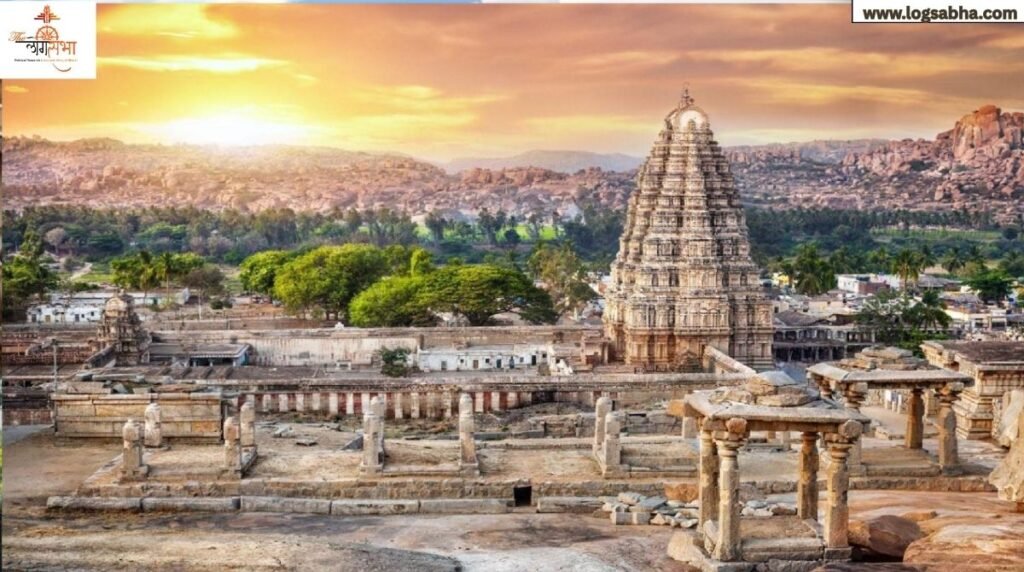
Empires vanish. Stones remember. In 1865, while the world had forgotten Vijayanagara, Hampi’s shattered gods stood unbowed proof that conquest can destroy cities, but never spirit.
Hampi, situated in the Ballari district of Karnataka, India, is a UNESCO World Heritage Site renowned for preserving the remains of the Vijayanagara Empire’s imperial capital. Spanning over 4,100 hectares along the Tungabhadra River, the site comprises an extensive ensemble of temples, palaces, markets, water systems, and fortifications set amid dramatic granite boulder formations. At its height between the 14th and 16th centuries, Hampi ranked among the world’s largest and most prosperous cities, reflecting the political power, economic vitality, and cultural sophistication of medieval South India.
Historical Context
The foundation of Hampi is closely linked to the establishment of the Vijayanagara Empire in 1336 CE by Harihara I and Bukka Raya I. Emerging during a period of regional instability, the empire served as a southern stronghold against northern incursions while fostering economic and cultural growth. Known historically as Vijayanagara (“City of Victory”), the capital expanded rapidly under successive rulers.
During the reign of Krishnadevaraya (1509–1529 CE), the empire reached its zenith. Contemporary foreign travelers described the city as a flourishing global trade center, attracting merchants from Persia, Arabia, and Europe. The city’s prosperity ended abruptly after the Battle of Talikota in 1565 CE, when a coalition of Deccan Sultanates defeated the Vijayanagara forces. The capital was subsequently plundered and abandoned, leaving behind the monumental ruins visible today.
Hampi remained largely forgotten until its documentation by British surveyors in the early 19th century. Its inscription as a UNESCO World Heritage Site in 1986 acknowledged its exceptional universal value, though concerns over conservation briefly placed it on the endangered list in the late 20th century.
Architectural and Urban Significance
Hampi exemplifies the Vijayanagara architectural style, characterized by monumental granite construction, elaborate carvings, and integrated urban planning. The city was organised into distinct sacred, royal, and commercial zones, reflecting a highly structured civic vision.
Religious monuments dominate the landscape. The Virupaksha Temple, active since at least the 7th century CE, remains a living center of worship. The Vittala Temple complex, famed for its stone chariot and musical pillars, demonstrates remarkable advances in engineering and artistic expression. Other structures, such as the Hazara Rama Temple and Ugra Narasimha statue, further illustrate the narrative and sculptural richness of the period.
Secular architecture within the Royal Enclosure includes palaces, ceremonial platforms, and advanced water-management systems. Notably, structures like the Lotus Mahal and Elephant Stables display Indo-Islamic stylistic influences, highlighting cultural interaction and administrative adaptability.
Cultural Life and Society
Hampi was a cosmopolitan city marked by religious plurality and artistic patronage. While Hinduism formed the ideological core of the empire, Jain communities, Muslim traders, and foreign visitors played visible roles in the city’s social fabric. Literary and traveler accounts describe vibrant festivals, music, commerce, and intellectual exchange.
The region is also deeply embedded in Indian mythology. Identified with Kishkindha from the Ramayana, sites such as Anjanadri Hill believed to be Hanuman’s birthplace add mythological depth to Hampi’s historical identity.
Preservation and Contemporary Relevance
Hampi’s enduring importance lies in its comprehensive portrayal of a medieval imperial city, offering insights into governance, architecture, economy, and cultural coexistence. Today, the site attracts over a million visitors annually, contributing significantly to regional tourism.
However, this popularity brings challenges, including environmental erosion, tourism pressure, and urban encroachment. Conservation efforts led by the Archaeological Survey of India emphasize sustainable tourism, controlled development, and community engagement to protect the site’s integrity.
Conclusion
Hampi stands as a powerful testament to the ambition, creativity, and complexity of the Vijayanagara civilization. Its ruins narrate a story of imperial grandeur, cultural synthesis, and historical rupture, while its continued study and preservation underscore the importance of safeguarding shared human heritage. As both an archaeological treasure and a cultural symbol, Hampi remains central to understanding India’s medieval past and its lasting legacy.
The Musical (SaReGaMa) Pillars of the Vijaya Vittala Temple, Hampi
The musical pillars commonly known as the SaReGaMa pillars are among the most remarkable acoustic and architectural achievements of medieval India. Situated within the Ranga Mandapa of the Vijaya Vittala Temple at Hampi, these stone pillars are renowned for producing distinct musical tones when gently tapped. Their ability to mimic the sounds of percussion, string, and wind instruments reflects an advanced understanding of acoustics integrated into sacred architecture during the Vijayanagara period.
Historical Background
The Vijaya Vittala Temple, dedicated to Lord Vittala, a form of Vishnu, was constructed and expanded between the 15th and early 16th centuries under the patronage of the Vijayanagara rulers. Early construction phases are attributed to the reign of Devaraya II, with significant additions during the rule of Krishnadevaraya. The musical pillars were likely introduced during this period of architectural expansion, when the temple evolved into a ceremonial and cultural center.
Historically, these pillars are believed to have been used during devotional performances, enhancing ritual chants and musical offerings. Following the decline of the Vijayanagara Empire after the Battle of Talikota in 1565 CE, Hampi was largely abandoned, yet the Vittala Temple remained structurally intact. Due to conservation concerns, physical interaction with the pillars is now prohibited.
Architectural Design and Acoustic Principles
The Ranga Mandapa contains 56 musical pillars, arranged in clusters. Each primary pillar is accompanied by smaller subsidiary pillars that together produce tonal variations corresponding to the seven basic notes of Indian classical music Sa, Re, Ga, Ma, Pa, Dha, and Ni.
Although carved from granite, a material typically considered acoustically rigid, the pillars possess unique resonant properties. This is attributed to a combination of high silica content, internal cavities, and precisely calibrated dimensions. These internal hollow sections function as resonance chambers, amplifying vibrations much like the sound box of a musical instrument.
Differences in pitch arise from variations in pillar length, thickness, and internal structure. Some pillars generate tones resembling percussion instruments such as the mridanga, while others evoke stringed or wind instruments. Scholars have broadly categorized these pillars according to pitch (shruti), melody (gana), and rhythm (laya), reflecting a systematic acoustic design.
Cultural Significance
Sound occupies a central place in Indian philosophical traditions, often conceptualized as divine (nada brahma). The musical pillars therefore transformed the temple into a multisensory sacred space, where architecture itself participated in ritual performance. While similar pillars exist in other South Indian temples, those at Vittala are exceptional in scale, tonal clarity, and architectural integration.
Analysis and Preservation
The musical pillars exemplify the empirical scientific knowledge of Vijayanagara artisans, who achieved acoustic precision without modern instrumentation. Their creation reflects a sophisticated synthesis of engineering, aesthetics, and spirituality. Today, preservation remains a key concern, as environmental exposure and tourism-related stress threaten their structural integrity. Conservation measures aim to balance protection with public appreciation of this extraordinary heritage.
Conclusion
The musical pillars of the Vijaya Vittala Temple represent a rare fusion of music and stone, embodying the intellectual and artistic excellence of the Vijayanagara civilization. Beyond their acoustic novelty, they stand as enduring symbols of a culture in which sound, structure, and spirituality were deeply intertwined, resonating silently as monuments to human ingenuity.
Overview of the Virupaksha Temple, Hampi
The Virupaksha Temple, also known as the Pampapati Temple, is a historic Hindu shrine dedicated to Lord Virupaksha, a form of Shiva, located in Hampi, Karnataka. Situated on the southern bank of the Tungabhadra River, the temple forms a core part of the UNESCO World Heritage Site Group of Monuments at Hampi. Notably, it is one of the oldest temples in India to have maintained uninterrupted worship, continuing as a living religious center to this day.
Historical Background
The origins of the Virupaksha Temple date back to the 7th century CE, when it began as a modest Shaiva shrine during the early Chalukya period. Inscriptions from the 9th and 10th centuries attest to its early prominence. Between the 13th and 16th centuries, the temple underwent major expansion under the Vijayanagara Empire, as Hampi rose to prominence as its imperial capital.
Significant architectural development occurred during the reign of Deva Raya II (r. 1422–1446 CE), under the patronage of the local governor Lakkan Dandesha. The temple reached its architectural peak under Krishnadevaraya (r. 1509–1529 CE), who commissioned the construction of the monumental eastern gopuram in 1510 CE. After the Battle of Talikota in 1565 CE, much of Hampi was destroyed, yet the Virupaksha Temple survived largely due to its continuous religious use. In 1986, it was officially recognized as part of the UNESCO World Heritage Site.
Mythologically, the temple is associated with the Ramayana and the sacred landscape of Pampakshetra, believed to be the site where Shiva married Parvati in her form as Pampa.
Architectural Features
The Virupaksha Temple reflects the Dravidian architectural tradition enriched by Vijayanagara-era innovations. The complex contains three prominent gopurams (gateway towers), the tallest being the eastern gopuram, which rises approximately 49 meters (160 feet) and consists of nine elaborately sculpted tiers depicting deities, celestial beings, dancers, and mythological scenes.
The inner sanctum (garbhagriha) houses the Shiva lingam, while subsidiary shrines are dedicated to Goddess Pampa and Goddess Bhuvaneshwari. The Ranga Mandapa, a pillared hall with 38 ornate columns, features yali (mythical lion-like figures) and reliefs drawn from the Ramayana and Mahabharata. Its ceiling preserves remnants of painted mythological imagery.
A distinctive architectural feature is the optical projection system within the temple, where a small aperture casts an inverted image of the gopuram onto an interior wall, demonstrating advanced knowledge of light and spatial design. Additional structures include a kalyana mandapa used for ceremonial processions, an extended pillared corridor leading to a large Nandi statue, and outer walls richly carved with divine and natural motifs.
Religious Importance and Festivals
As the only temple in Hampi to have remained continuously active since antiquity, Virupaksha holds exceptional religious significance. It remains a major pilgrimage destination, especially during festivals such as Maha Shivaratri and the annual rathotsava (chariot festival), when the deity is ceremonially paraded through the temple complex.
Preservation and Visiting Information
The temple is open daily from early morning until evening, with free entry for visitors, though nominal fees apply for photography. The most suitable time to visit is between October and March, when weather conditions are favorable. Managed by the Archaeological Survey of India, the temple faces ongoing challenges related to environmental exposure and tourism pressure, yet it remains one of the best-preserved monuments in Hampi.
Conclusion
The Virupaksha Temple stands as a powerful symbol of continuity, resilience, and devotion. Bridging mythology, imperial history, and living religious practice, it represents not only the architectural brilliance of the Vijayanagara era but also the enduring spiritual traditions that have sustained it for more than a millennium.
Architecture of the Virupaksha Temple, Hampi
The Virupaksha Temple, also known as the Pampapati Temple, stands as one of the finest and most enduring examples of Dravidian temple architecture shaped by Vijayanagara artistic vision. Located in Hampi, Karnataka, the temple is dedicated to Lord Virupaksha (a manifestation of Shiva) and his consort Pampa. Oriented along an east–west axis, it occupies a central position within the sacred and urban fabric of Hampi and remains one of the oldest continuously active Hindu temples in India.
Historical Development
The origins of the Virupaksha Temple date back to the 7th century CE, when it began as a modest shrine under early Deccan dynasties. Its architectural transformation occurred primarily between the 14th and 16th centuries during the Vijayanagara Empire. Significant expansion was undertaken by Lakkan Dandesha, a regional governor during the reign of Deva Raya II (1422–1446 CE), who initiated the construction of the monumental eastern gateway. Subsequent additions under Krishnadevaraya (1509–1529 CE) elevated the temple to the status of the principal royal shrine of Vijayanagara.
While much of Hampi was devastated after the Battle of Talikota in 1565 CE, the Virupaksha Temple survived largely intact due to the continuity of worship, ensuring its preservation through centuries of political and social change.
Architectural Composition – Gateway Towers (Gopurams)
The temple complex is accessed through three gopurams, the most imposing of which is the eastern gopuram, rising approximately 49 meters and comprising nine tiers. Constructed with a granite base and brick superstructure, it is adorned with stucco sculptures depicting deities, celestial figures, dancers, and mythological beings. The gopuram serves both as a visual landmark and as a ceremonial threshold.
Sanctum and Inner Spaces
The garbhagriha houses the Shiva linga of Lord Virupaksha and is approached through a sequence of antechambers that guide devotees inward both physically and symbolically. Shrines dedicated to Pampa and Bhuvaneshwari reinforce the temple’s theological framework. A distinctive architectural feature is the pinhole projection that casts an inverted image of the eastern gopuram onto an interior wall, demonstrating sophisticated understanding of light and optics.
Mandapas and Ritual Halls
The Ranga Mandapa is supported by 38 elaborately carved granite pillars, decorated with yali figures, warriors, and narrative panels from the Ramayana and Mahabharata. Additional open mandapas, cloisters, and courtyards accommodate ritual movement, congregational worship, and festival processions. A separate kalyana mandapa is used for ceremonial celebrations associated with the divine marriage.
Materials and Construction Techniques
The temple is primarily constructed from locally sourced granite using dry masonry methods. Brick was employed for upper structural elements, particularly in the gopurams. Quarry marks and assembly indicators on stone blocks suggest careful planning and advanced construction management.
Religious and Cultural Significance
As the only monument in Hampi to maintain uninterrupted religious activity, the Virupaksha Temple continues to function as the spiritual nucleus of the region. Major festivals such as Maha Shivaratri and the annual chariot procession draw thousands of devotees, sustaining traditions that date back over a millennium.
Conclusion
The Virupaksha Temple represents a rare convergence of architectural mastery, religious continuity, and historical resilience. Its survival amid widespread destruction highlights the enduring power of sacred institutions, while its architectural sophistication reflects the Vijayanagara Empire’s lasting contribution to India’s cultural and artistic heritage.
The Stone Chariot of Hampi
The Stone Chariot, also known as the Garuda Shrine, is one of the most iconic monuments within the Vittala Temple complex at Hampi, Karnataka. Carved entirely from granite, this architectural masterpiece is designed to resemble a ceremonial temple chariot (ratha) and stands as a powerful symbol of the artistic sophistication and engineering excellence of the Vijayanagara Empire. As part of the UNESCO-listed Group of Monuments at Hampi, the Stone Chariot has become a national emblem, famously depicted on India’s ₹50 currency note.
Historical Background
The Stone Chariot dates to the 15th–early 16th century, during the height of Vijayanagara rule. It is generally attributed to the reigns of Deva Raya II (1422–1446 CE) or Krishnadevaraya (1509–1529 CE), under whom temple architecture flourished. Inspired by earlier monumental chariots, most notably the Sun Temple at Konark, the structure was conceived as a shrine dedicated to Garuda, the divine mount of Lord Vishnu (Vittala), rather than as a movable vehicle.
Although Hampi suffered widespread destruction after the Battle of Talikota in 1565 CE, the Stone Chariot survived largely intact, underscoring its symbolic importance and continued ritual significance.
Architectural Features
Contrary to popular belief, the Stone Chariot is not monolithic. It is assembled from carefully jointed granite blocks that create the illusion of a single carved structure. The chariot rests on a raised platform decorated with reliefs depicting mythological and martial themes.
It features four elaborately carved stone wheels, originally designed to rotate on axles but now fixed for preservation. The front is adorned with stone elephants, which replaced the original horses, remnants of whose hind legs are still visible. Between the elephants lies a damaged stone staircase leading to the inner sanctum.
The chariot’s surfaces are richly sculpted with images of deities, celestial figures, animals, and ornamental pilasters. Traces of natural pigments suggest that the monument was once brightly painted, enhancing its ceremonial presence.
Religious and Cultural Significance
Functioning as a Garuda shrine, the Stone Chariot symbolized devotion to Vishnu and formed an integral part of temple rituals. It is one of only three prominent stone chariots in India, alongside those at Konark (Odisha) and Airavatesvara (Tamil Nadu). Local tradition surrounds the chariot with mythic reverence, reinforcing its sacred status.
Preservation and Legacy
Today, the Stone Chariot is carefully protected by the Archaeological Survey of India. Physical contact, climbing, or attempts to move the structure are strictly prohibited to prevent damage from weathering and tourism pressure.
More than a sculptural marvel, the Stone Chariot represents the ceremonial imagination of the Vijayanagara world, where architecture served as a medium of devotion, symbolism, and imperial identity. Its endurance amid the ruins of Hampi makes it a lasting testament to India’s architectural and cultural legacy.
The Hidden Genius of Hampi: Vijayanagara’s Drainage and Water Management System
Beyond Hampi’s monumental temples and sculpted stone lies one of the most sophisticated yet understated achievements of the Vijayanagara Empire, its advanced drainage and water-management system. Developed between the 14th and 16th centuries CE, this network enabled a vast imperial capital to thrive in a dry, rocky landscape, demonstrating an exceptional understanding of hydraulics, urban planning, and environmental balance.
Geography and the Need for Innovation
Hampi is situated along the Tungabhadra River in a semi-arid zone marked by erratic rainfall and granite-heavy terrain. Managing seasonal floods during monsoons while ensuring year-round water availability posed a significant challenge. Vijayanagara engineers addressed this through a gravity-driven drainage system that regulated water flow without mechanical intervention, integrating natural topography into urban design.
Structural Components of the System
Canals and Water Diversions
A network of stone-lined canals diverted water from the Tungabhadra using low weirs known as anicuts. These channels followed gentle gradients, allowing water to travel long distances efficiently. Constructed with interlocking granite blocks and no mortar, the canals were durable, resistant to erosion, and capable of managing sediment flow.