
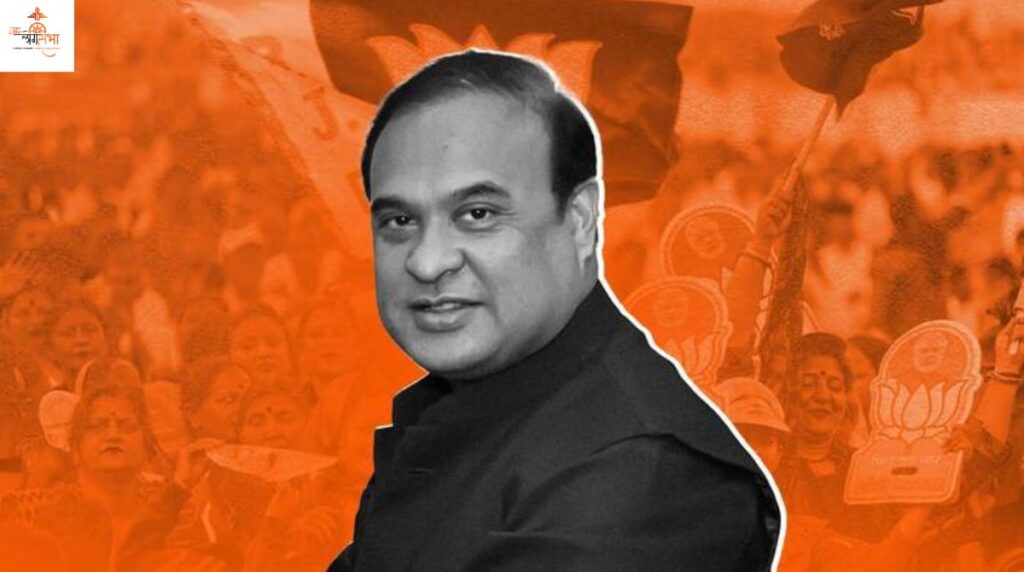
For Himanta Biswa Sarma, the 2026 election is no ordinary contest it is a direct test of his leadership, his politics, and the narrative he has built around power and identity.
Himanta Biswa Sarma is not just the Chief Minister of Assam he is the axis around which the state’s contemporary politics now revolves. Since assuming office in 2021 under the banner of the Bharatiya Janata Party, Sarma has done more than govern; he has fundamentally re-scripted Assam’s political narrative.
But this transformation comes with a question that refuses to fade: is Sarma building a stronger Assam or a more polarised one?
From Congress Insider to BJP Powerhouse
Sarma’s political journey is not one of ideological consistency it is one of calculated reinvention. Once a trusted lieutenant of Tarun Gogoi, he abandoned the Congress at a moment of internal decay and re-emerged as the BJP’s most formidable strategist in the Northeast.
His 2015 switch was not merely a party change it was a power shift that dismantled Congress dominance and laid the foundation for a new political order.
Governance with Speed and a Message
As Chief Minister, Sarma has cultivated the image of a leader who delivers fast, visible, and unapologetic. Investment summits, global outreach such as the World Economic Forum Annual Meeting 2026, and industrial pushes involving the Tata Group signal ambition beyond Assam’s traditional economic confines.
Welfare schemes like Orunodoi have deepened his connect with women and rural voters. Infrastructure, investment, and administrative responsiveness have given his government a veneer of efficiency rarely associated with the region’s past.
Yet, governance under Sarma is never just about delivery it is always accompanied by a narrative.
Identity as Politics, Politics as Identity
At the heart of Sarma’s politics lies a sharp, unmistakable emphasis on identity. His aggressive stance on illegal immigration, land reclamation drives, and rhetoric around cultural preservation have struck a chord with large sections of Assamese society.
But this same approach has also drawn accusations of deliberate polarisation. Critics argue that Sarma has blurred the line between governance and ideological mobilisation turning identity into a political instrument. Supporters, however, see him as the first leader in decades willing to confront uncomfortable demographic realities head-on.
This is the paradox of Sarma: decisive to some, divisive to others.
Power, Controversy, and Control
Sarma’s rise has not been free of controversy. From past allegations during his Congress years to fresh political attacks involving his family, he has consistently dismissed criticism as politically motivated.
What remains undeniable, however, is his firm grip over Assam’s political machinery. Few leaders in the region command as much organisational control, narrative dominance, and electoral influence.
2026: A Referendum on One Man
The 2026 Assam Assembly elections are not merely a contest between parties they are a direct verdict on Himanta Biswa Sarma himself.
For the BJP, he is the face, the strategist, and the message. For the opposition, he is the symbol of everything they seek to challenge. The election, therefore, is less about ideology and more about whether Sarma’s model of governance development fused with assertive identity politics has public approval.
The Larger Question
Sarma has undeniably shifted Assam away from the shadows of insurgency and political stagnation. He has injected urgency, direction, and ambition into governance.
But in doing so, he has also sharpened social and political fault lines.
Conclusion: Builder or Divider?
Himanta Biswa Sarma represents a new, unapologetic template of leadership decisive, strategic, and deeply political. He is both the builder of a more confident Assam and the face of its intensifying divisions.
His success lies not just in what he has built but in how long he can sustain it without deepening the fractures beneath.
As Assam votes in 2026, the real question is no longer about parties. It is about one man and the future he represents.
Early Life and Education of Himanta Biswa Sarma
Himanta Biswa Sarma was born on February 1, 1969, in Jorhat, Assam, into a modest middle-class family. His father, Kailash Nath Sarma, was a school teacher, and his mother, Mrinalini Devi, a homemaker. Raised in a disciplined and education-focused environment, he imbibed values of hard work, integrity, and intellectual curiosity from an early age.
Formative Years and Influences
Sarma spent his early years in Jorhat before moving to Guwahati for his education. His father’s academic background played a crucial role in shaping his respect for learning and structured thinking.
His political consciousness developed early, particularly during the Assam Movement (1979–1985), led by the All Assam Students’ Union (AASU). The movement’s focus on identity, migration, and cultural preservation left a deep and lasting imprint on his worldview.
As a student, he actively engaged in AASU-led activities, gaining first-hand exposure to grassroots mobilisation and public discourse.
Education and Legal Foundation
He completed his schooling in Guwahati, where he distinguished himself in academics as well as debating and public speaking.
He went on to earn a Bachelor of Arts (BA) from Cotton College, followed by a Bachelor of Laws (LLB) from Gauhati University in the early 1990s.
Sarma began his professional career as an advocate at the Gauhati High Court (1996–2001). His legal training sharpened his analytical abilities, clarity of argument, and understanding of governance skills that later became hallmarks of his political career.
Transition to Politics
After a brief legal career, Sarma entered active politics in 2001. At the age of 32, he contested and won the Jalukbari Assembly seat, marking the beginning of his political rise.
His early life shaped by student activism, the socio-political currents of the Assam Movement, and a strong academic and legal foundation played a decisive role in forming his political ideology.
Himanta Biswa Sarma’s early journey reflects a blend of modest upbringing, intellectual discipline, and political awakening. These formative influences not only shaped his worldview but also laid the groundwork for his emergence as a key political figure in Assam and the wider Northeast.
Political Career of Himanta Biswa Sarma
Himanta Biswa Sarma has crafted one of the most dynamic political journeys in contemporary India. From a rising figure in the Congress to the driving force of the Bharatiya Janata Party in Assam, his career reflects strategic shifts, administrative strength, and sustained electoral relevance.
1. Early Electoral Success (2001–2006)
Sarma entered electoral politics in 2001, contesting from Jalukbari at the age of 32. His victory marked the beginning of a long and consistent political career.
Over the years, Jalukbari became his stronghold, with repeated wins establishing him as a leader with deep grassroots support and organisational control.
2. Congress Phase: Rise and Influence (2001–2015)
Under Tarun Gogoi, Sarma quickly rose through the ranks to become one of the most influential ministers in Assam.
Between 2006 and 2014, he handled key portfolios such as Health, Finance, Education, and Public Works, placing him at the core of governance.
Key Contributions
- Strengthened public health infrastructure.
- Expanded higher education institutions.
- Established a reputation as a result-oriented administrator.
Exit from Congress
By 2014–15, internal differences within the party became pronounced. Tensions with Gogoi and the rising prominence of Gaurav Gogoi reportedly reduced his influence.
At the same time, Sarma adopted a stronger position on issues like illegal immigration and regional identity.
In 2015, he left the Congress and joined the BJP an inflection point that reshaped both his career and Assam’s political landscape.
3. BJP Phase: Strategy and Breakthrough (2015–2021)
Sarma’s move to the BJP proved decisive. He played a central role in the party’s 2016 Assam victory, ending 15 years of Congress rule.
As a senior minister in the government led by Sarbananda Sonowal, he once again managed key departments, reinforcing his administrative credentials.
4. Chief Ministership (2021–Present)
In May 2021, Sarma became Chief Minister, marking the peak of his political ascent. His tenure has been defined by assertive governance and a strong political narrative.
Key Focus Areas
- Governance & Land Policy: Large-scale anti-encroachment initiatives.
- Economic Growth: Push for industrial investment, including projects linked to the Tata Group.
- Cultural Identity: Promotion of Assamese heritage and historical recognition.
- Welfare: Targeted schemes for women and grassroots communities.
- Migration Policy: Firm stance on illegal immigration.
5. Leadership Style
Sarma’s political approach combines strategy with execution:
- Skilled in electoral planning and alliance-building.
- Strong communicator with wide public appeal.
- Blends regional identity politics with national narratives.
- Focuses on delivery, speed, and visible governance outcomes.
6. Current Context (2026 Elections)
As Assam heads into the 2026 Assembly elections, Sarma stands at the centre of the political contest. The election is widely seen as a referendum on his leadership and governance model.
A strong mandate could elevate his national stature within the BJP, while a setback may challenge his political momentum.
Conclusion
Himanta Biswa Sarma’s political career is defined by adaptability, strategic clarity, and administrative effectiveness. From a Congress insider to the BJP’s most influential leader in the Northeast, he has consistently shaped and reshaped the political narrative of Assam.
Today, he remains a dominant yet contested figure, with his future closely tied to the outcome of the 2026 elections and his evolving role in national politics.
Key Achievements of Himanta Biswa Sarma as Chief Minister (2021–2026)
Since taking office in May 2021, Himanta Biswa Sarma has pursued an assertive governance model in Assam marked by rapid execution, visible outcomes, and a blend of development and identity politics.
1. Economic Push and Investment Drive
Sarma has repositioned Assam as an emerging investment destination. His outreach at platforms like the World Economic Forum Annual Meeting 2026 reflects an effort to attract global attention to the state’s economic potential.
A major milestone has been the proposed semiconductor project by the Tata Group in Jagiroad, alongside investments in green energy, petrochemicals, tourism, and food processing.
Parallelly, infrastructure development roads, bridges, airports, and rural electrification has accelerated, supporting broader economic growth.
2. Anti-Encroachment Drive
The anti-encroachment campaign stands out as his most defining and controversial initiative. The government reports reclaiming over 1.5 lakh bighas of land, including forest areas and wetlands.
Framed as a measure to protect indigenous land rights and ecological balance, it has also drawn criticism for its social and political implications.
3. Cultural and Heritage Focus
Sarma’s tenure has strongly emphasised cultural identity. A key achievement was securing UNESCO World Heritage status for the Ahom moidams in 2024, elevating Assam’s historical legacy globally.
The government has also promoted traditional institutions such as satras and namghars, reinforcing Assamese cultural consciousness.
4. Welfare and Social Schemes
His administration has prioritised targeted welfare delivery.
The Orunodoi scheme provides direct financial assistance to millions of women, while Swanirbhar Naari supports livelihoods for weavers and artisans.
Efforts to strengthen healthcare and education especially in rural areas have complemented these initiatives.
5. Governance and Administrative Reforms
Sarma’s governance style is defined by speed and centralised decision-making.
Key measures include single-window clearance for industries, expansion of digital governance, and a stronger focus on law and order. His government has also emphasised implementation of the Assam Accord and NRC-related processes.
6. Regional Political Influence
As convenor of the North-East Democratic Alliance (NEDA), Sarma has played a crucial role in expanding the BJP’s footprint across the Northeast, while maintaining coalition stability within Assam.
Assessment
Achievements:
- Strengthened Assam’s investment profile.
- Delivered visible infrastructure and welfare outcomes.
- Asserted cultural identity and heritage.
- Consolidated political influence in the region.
Criticism:
- Anti-encroachment drive seen as contentious.
- Welfare schemes criticised as populist.
- Accusations of increasing social polarisation.
Conclusion
Himanta Biswa Sarma’s tenure reflects a decisive and high-impact style of governance. By combining economic ambition with identity politics, he has reshaped Assam’s political and developmental narrative.
As the state heads into the 2026 elections, his record both transformative and contested remains at the centre of public judgment.
Controversies and Criticisms of Himanta Biswa Sarma (April 2026)
Himanta Biswa Sarma remains one of the most polarising figures in Indian politics. His tenure in Assam has been defined by decisive governance and strong political messaging, but also by controversies that continue to shape public perception and electoral debate.
1. Anti-Encroachment Drive
The large-scale eviction campaigns undertaken since 2021 are the most defining and contentious aspect of his governance.
Criticism:
Opposition parties and civil society groups argue that the drive has disproportionately affected Bengali-speaking Muslim communities and, at times, led to violent confrontations.
Government’s Stand:
Sarma has consistently defended the policy as a legal necessity aimed at protecting public land, ecological balance, and indigenous rights.
2. Identity Politics and Rhetoric
Sarma’s assertive stance on illegal immigration and his use of terms like “Miya” have generated significant controversy.
Criticism:
Detractors accuse him of deepening religious and linguistic divisions and using identity politics to consolidate support.
Supporters’ View:
Supporters argue that his approach reflects long-standing concerns over demographic change and the need to safeguard Assamese identity.
3. Personal Allegations (2026 Election Context)
In the run-up to the 2026 Assembly elections, opposition parties have raised allegations regarding his wife’s alleged foreign assets and citizenship status.
Sarma has rejected these claims as baseless and politically motivated, though the issue has become a prominent campaign theme.
4. Past Allegations
During his Congress years, Sarma was linked to controversies such as the Louis Berger case and the Saradha chit fund matter.
No convictions have resulted, and he has maintained that the allegations were politically driven.
5. Handling of Dissent
His administration has faced criticism over its response to protests and dissent, particularly concerning eviction drives and citizenship-related issues.
Some civil society groups and journalists have raised concerns about restrictions on expression, while the government maintains that its actions are guided by law-and-order priorities.
6. Development vs Ground Realities
While Sarma has promoted Assam as an emerging investment destination, critics argue that challenges such as unemployment, floods, and rural distress persist.
There are also concerns about centralisation of power and a governance style concentrated around the Chief Minister’s office.
Overall Assessment
Supporters:
- See him as decisive and action-oriented.
- Credit him with protecting land and indigenous identity.
- Appreciate visible governance outcomes.
Critics:
- Question the neutrality of policy implementation.
- Highlight concerns over centralised governance.
Conclusion
Himanta Biswa Sarma’s leadership embodies both impact and controversy. His policies have reshaped Assam’s political narrative, but also intensified debates on identity, governance, and inclusion.
As the 2026 elections approach, these controversies remain central to how his tenure will ultimately be judged.
Current Status of Himanta Biswa Sarma (April 2026)
As of April 2026, Himanta Biswa Sarma is at a decisive moment in his political journey. Assam is voting in Assembly elections (April 9; results May 4), and the contest has effectively become a direct verdict on his leadership, governance model, and political messaging.
Position and Political Weight
Sarma has led Assam since May 2021 and remains the undisputed face of the Bharatiya Janata Party-led alliance in the state. He is seeking a second consecutive term an important milestone for the party.
He holds firm control over party organisation, campaign strategy, and governance, and is widely regarded as the most influential political figure in Assam today, with growing relevance at the national level.
Election Landscape: A Personal Referendum
The 2026 election is centred around Sarma himself. His campaign is built on three pillars:
- Development: Infrastructure growth, industrial investment, and economic expansion.
- Identity: Protection of Assamese culture, land, and demographic balance.
- Governance: Strong law-and-order narrative and decisive administration.
His high-energy campaign style has reinforced his position as both the face and force of the BJP’s electoral push.
Key Factors Shaping His Image
Governance vs Ground Reality
Sarma projects a record of visible development, welfare delivery, and investment inflow. Supporters see this as a clear shift toward a more dynamic Assam.
Critics counter that core issues unemployment, price rise, and regional disparities remain unresolved.
Identity and Polarisation Debate
His assertive stance on land, migration, and encroachment remains central to his politics.
While supporters view this as protection of indigenous rights, critics argue it has deepened social divisions.
Public Perception
- Supporters: See him as decisive, efficient, and fearless.
- Critics: View him as centralising power and fostering polarisation.
- Neutral observers: Often describe him as one of Assam’s most powerful and polarising leaders in recent decades.
National Significance
Within the BJP, Sarma is seen as a key regional strategist with rising national stature. A strong electoral performance could elevate his role beyond Assam and strengthen his position within the party’s broader leadership.
Conclusion
Himanta Biswa Sarma enters the 2026 elections at the peak of his influence, but also under intense scrutiny. His blend of development-driven governance and assertive identity politics now faces its ultimate test.
The outcome will not only shape Assam’s political future but also determine Sarma’s trajectory as a significant force in national politics.
Political Analysis and Significance of Himanta Biswa Sarma (April 2026)
Himanta Biswa Sarma has emerged as one of the most influential and debated political leaders in contemporary India. His rise has not only transformed the political landscape of Assam but has also played a crucial role in expanding the footprint of the Bharatiya Janata Party across the Northeast. His leadership represents a blend of strategic precision, administrative assertiveness, and ideological positioning.
Political Analysis
1. Strategic Acumen and Alliance Building
Sarma is widely regarded as a master political strategist. His role in the BJP’s 2016 breakthrough in Assam marked a decisive shift in the state’s political trajectory.
As a key force behind the North-East Democratic Alliance (NEDA), he has successfully built and managed alliances across the Northeast, often reshaping regional power structures. His ability to attract leaders from rival parties reflects both tactical flexibility and strong organisational control.
2. Ideological Positioning: A Calculated Blend
Sarma’s politics is defined by a calibrated fusion of Assamese sub-nationalism and Hindutva.
He emphasises the protection of language, culture, and land rights while aligning with the BJP’s broader ideological framework. This dual approach has allowed him to expand the party’s reach among indigenous communities that were historically cautious of national parties.
3. Governance Style: Decisive yet Centralised
His leadership is characterised by swift decision-making and tight administrative control. Policies are implemented with speed and visibility, reinforcing his image as an action-oriented leader.
Supporters interpret this as efficiency and clarity of governance, while critics argue that such centralisation risks marginalising institutional processes and dissent.
4. Communication and Public Engagement
Sarma’s effectiveness as a communicator has been central to his political success. Fluent across multiple languages, he connects with diverse audiences from urban youth to rural voters.
Through sustained public outreach and active narrative-building, he has maintained a strong presence in both traditional and digital political spaces.
5. Polarisation and Political Strategy
A defining feature of Sarma’s politics is his assertive stance on issues such as illegal immigration, land rights, and cultural identity.
While this has consolidated a loyal support base, it has also intensified social and political divisions. His approach is seen by supporters as necessary and candid, and by critics as exclusionary and polarising.
Political Significance
For Assam and the Northeast
Sarma has reoriented Assam’s political discourse shifting it from concerns of insurgency and stagnation to a framework centred on development and identity assertion.
His governance model, which combines regional aspirations with national political alignment, is increasingly viewed as a template for expanding national parties in culturally distinct regions.
For the BJP
He is among the BJP’s most successful regional leaders outside the Hindi heartland. His ability to secure and retain power in a diverse and complex state like Assam has strengthened the party’s position in the Northeast and reinforced its broader national strategy.
National Implications
The 2026 Assam Assembly elections carry significant implications for Sarma’s future. A strong mandate would likely elevate his stature within the BJP and position him as a key national figure.
Conversely, any electoral setback could limit his influence and reshape his political trajectory.
Strengths and Limitations
Strengths:
- Strong strategic thinking and organisational command.
- Proven administrative effectiveness.
- Ability to shape political narratives and mobilise support.
Limitations:
- Highly polarising public image.
- Criticism over majoritarian rhetoric.
- Concerns regarding concentration of power.
Conclusion
Himanta Biswa Sarma represents a new, assertive model of regional leadership one that combines development-driven governance with a strong emphasis on identity politics. He has not only reshaped Assam’s political landscape but also influenced the BJP’s expansion strategy in the Northeast.
At the same time, his leadership remains deeply contested. As Assam heads into a decisive electoral moment in 2026, the outcome will determine whether his model is consolidated further or begins to face limits.
He remains, undeniably, one of the most closely watched and consequential political figures in India today.
Himanta Biswa Sarma vs Pawan Khera: When Elections Turn into Personal Combat (April 2026)
The confrontation between Himanta Biswa Sarma and Pawan Khera has pushed the 2026 election in Assam into a far more confrontational space than routine democratic contestation. In the final days before polling, the campaign has shifted decisively from governance and development to a high-stakes battle over credibility, power, and perception.
A Trigger Designed to Disrupt
Khera’s allegations questioning financial disclosures and citizenship-linked claims involving the Chief Minister’s family were not incidental. They were timed and framed to puncture Sarma’s political authority at a critical electoral moment.
The intent was clear: to force a defensive posture. The outcome, however, was the opposite.
Escalation and the Question of Power
The swift move to legal action, followed by police intervention, transformed the controversy into something larger than politics. It raised a fundamental question:
Is this accountability being pursued or authority being asserted?
For critics, the optics suggest the blurring of lines between political response and state power. For supporters, it reflects a leadership unwilling to allow allegations true or false to go unanswered. The ambiguity itself has become politically consequential.
Sarma’s Play: Control the Narrative
Sarma has not reacted defensively; he has seized control of the narrative. His response sharp, public, and unapologetic recasts the controversy as a politically motivated attack rather than a question of substance.
This is strategic. By shifting the debate from what is being alleged to why it is being alleged, he consolidates his support base and reframes the confrontation on his own terms.
Congress’s Calculated Risk
For Khera and the Congress, the move is high-risk by design. It has succeeded in disrupting the campaign and drawing national attention.
But it also demands proof. If the allegations hold, they could damage Sarma’s credibility. If they falter, they risk being dismissed as opportunistic politics in the heat of an election. There is little middle ground.
What This Reveals About the Election
This episode is not an exception it is a reflection of how electoral politics is evolving.
The Assam election, in its final phase, has moved away from policy discourse toward narrative warfare. Personal credibility, legal confrontation, and political theatre now dominate the conversation, overshadowing substantive debate.
Conclusion: Beyond Allegations, A Test of Political Culture
The Sarma–Khera clash is more than a controversy it is a window into the current grammar of Indian politics. It reveals a landscape where perception often outweighs policy, and confrontation becomes a strategy rather than a consequence.
As Assam votes, the electorate is not only choosing a government. It is, in effect, deciding whether this style of politics sharp, personal, and relentlessly combative is one it is prepared to endorse.
Strip away the rhetoric, and the choice is stark: governance or spectacle, persuasion or confrontation. What Assam decides at the ballot box will echo far beyond this election it will define the tone of its politics for years to come.