
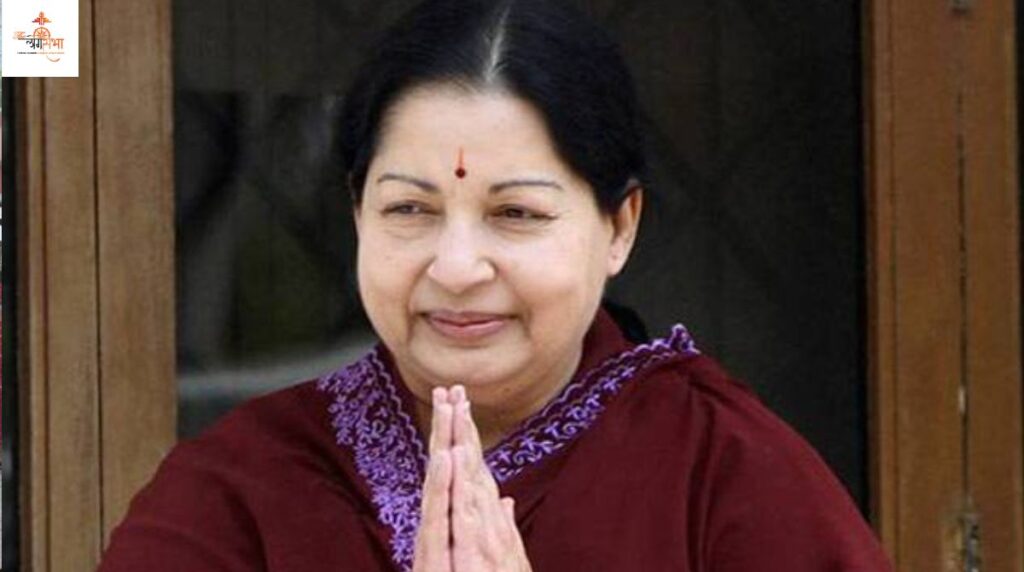
In Tamil Nadu, power was never just institutional it was personal. And few embodied that truth more completely than J. Jayalalithaa, whose death marked the close of a uniquely leader-driven political era.
Few leaders in Indian politics have combined authority, mass appeal, and controversy as completely as J. Jayalalithaa. Known to millions as “Amma”, she was not just a Chief Minister she was the central force that defined politics in Tamil Nadu for decades.
Her journey from cinema to power was remarkable, but what set her apart was not her rise it was her ability to dominate and endure.
From Screen Presence to Political Power
Jayalalithaa’s entry into politics, aided by her association with M. G. Ramachandran, was only the beginning. After his death, she faced intense resistance within her own party.
What followed was a decisive consolidation of authority transforming her from a political inheritor into the undisputed leader of the All India Anna Dravida Munnetra Kazhagam. Her rise was not inherited; it was earned through political assertion and control.
Authority and Centralisation
Her leadership style was unmistakably centralised. Power flowed through her, decisions were tightly controlled, and political authority was rarely diffused.
To supporters, this meant efficiency and decisiveness. To critics, it signified authoritarianism.
Either way, it ensured one thing: there was no ambiguity about who governed.
Controversy and Comeback
Jayalalithaa’s career was marked by legal battles and corruption allegations, most notably the disproportionate assets case. Her conviction and temporary disqualification could have ended her career but it did not.
Her return to power demonstrated a rare political resilience and a deeply loyal voter base that remained largely unaffected by controversy.
Legacy Beyond Power
Even after her death in 2016, Jayalalithaa’s influence remains deeply embedded in Tamil Nadu’s political fabric.
- Welfare populism continues to dominate electoral strategy.
- AIADMK’s identity remains tied to her legacy.
- She stands as one of India’s most powerful women leaders.
Conclusion
Jayalalithaa was more than a political leader she was a system unto herself. She fused charisma with control, welfare with strategy, and symbolism with authority.
Her politics was not without flaws, but it was undeniably effective.
In the end, her greatest achievement was not just winning elections it was redefining how power is built, sustained, and remembered in Tamil Nadu.
Early Life and Film Career of J. Jayalalithaa
J. Jayalalithaa’s journey from a young girl facing personal adversity to a celebrated film star laid the foundation for her later political dominance. Born on 24 February 1948 in Melukote (present-day Karnataka) into a Tamil Iyengar Brahmin family, her early life was shaped by loss, discipline, and exposure to the cultural world of cinema.
Her father’s death when she was just two years old left her mother, Sandhya an actress in Tamil and Telugu films to raise the family. This early connection to cinema would eventually shape Jayalalithaa’s destiny.
Early Life and Education
Raised between Bangalore and Chennai, Jayalalithaa was known to be an academically gifted and disciplined student. She studied at Bishop Cotton Girls’ School and later at Presentation Convent in Chennai, where she excelled in her studies and extracurricular activities.
Despite her academic promise, financial realities and her mother’s profession led her toward acting at a young age marking a decisive shift in her life’s trajectory.
Entry into Cinema
Jayalalithaa entered films as a teenager, initially appearing in Kannada cinema before making her mark in Tamil films. By her late teens, she had transitioned into leading roles, quickly gaining recognition for her confidence, screen presence, and natural acting ability.
Her early success signalled the arrival of a star who would soon become one of the most prominent faces of South Indian cinema.
Rise to Stardom
Through the 1960s and 1970s, Jayalalithaa emerged as one of the leading actresses of her time, acting in over 140 films across multiple languages.
A defining feature of her career was her successful on-screen pairing with M. G. Ramachandran (MGR). Their films not only achieved commercial success but also created a powerful public association that would later carry political significance.
Unlike many of her contemporaries, she often portrayed confident and assertive characters, breaking away from traditional roles and strengthening her image as a strong and independent personality.
Transition to Politics
Jayalalithaa’s move into politics was a natural extension of her public image and mass appeal. In 1982, she joined the All India Anna Dravida Munnetra Kazhagam at the invitation of MGR.
Her cinematic popularity, communication skills, and emotional connect with the public provided her with a strong foundation as she stepped into political life.
Assessment
Her film career was not merely a phase it was the bedrock of her political identity. It gave her visibility, credibility, and a loyal mass following that few leaders could command from the outset.
More importantly, it equipped her with the confidence and stage presence that later defined her as a commanding political leader.
J. Jayalalithaa’s early life and film career were marked by resilience, talent, and transformation. From navigating personal challenges to achieving cinematic stardom, she built a powerful public persona that seamlessly transitioned into politics.
Her story illustrates how cinematic charisma, when combined with determination and strategic positioning, can evolve into enduring political authority a transformation few have achieved with such lasting impact.
Entry into Politics and Rise in AIADMK
The rise of J. Jayalalithaa from film icon to political powerhouse is one of the most compelling transitions in Indian politics. Her journey within the All India Anna Dravida Munnetra Kazhagam was not a smooth inheritance it was a contested climb marked by resistance, strategy, and eventual dominance.
Entry into Politics (1982)
Jayalalithaa entered politics in 1982 at the invitation of M. G. Ramachandran (MGR), then Chief Minister of Tamil Nadu. She was appointed Propaganda Secretary, a role that quickly made her one of the most visible faces of the party.
Her film stardom ensured instant recognition, but she went beyond symbolism travelling across the state, addressing rallies, and steadily building her own political base.
Early Growth and Internal Resistance (1984–1987)
Her election to the Rajya Sabha in 1984 marked her formal political entry. As MGR’s health declined, her responsibilities within the party increased, giving her administrative exposure.
However, her rapid rise also triggered internal opposition, as many within the party were reluctant to accept her authority.
The Power Struggle (1987–1989)
MGR’s death in 1987 plunged AIADMK into a bitter leadership crisis. The party split between factions led by Janaki Ramachandran and Jayalalithaa.
In a male-dominated political space, Jayalalithaa faced intense resistance but responded with political clarity and assertiveness. The 1989 elections proved decisive her faction emerged stronger, and she became Leader of the Opposition, marking her arrival as a serious political force.
Consolidation and Control
By the end of the decade, she had unified the party and established undisputed leadership. What began as a struggle for legitimacy turned into complete organisational control.
Her rise was defined by decisiveness, not gradual acceptance.
Chief Ministership (1991)
The 1991 Assembly elections marked the turning point. AIADMK’s sweeping victory brought Jayalalithaa to power, and at 43, she became Chief Minister of Tamil Nadu.
It was the culmination of a rapid and hard-fought political ascent.
Conclusion
Jayalalithaa’s rise within AIADMK was not driven by legacy alone it was built on strategy, resilience, and a sharp understanding of power. From a political entrant in 1982 to Chief Minister in 1991, she transformed herself into the central force of Tamil Nadu politics.
This phase did not just establish her leadership it defined the authority she would wield for decades to come.
J. Jayalalithaa as Chief Minister of Tamil Nadu
J. Jayalalithaa governed Tamil Nadu across five terms between 1991 and 2016, emerging as one of the most commanding and influential leaders in the state’s political history. Her tenure combined welfare-driven politics, strong administrative control, and sustained economic growth creating a model that continues to shape governance in Tamil Nadu.
Rise, Setbacks, and Return
Jayalalithaa first assumed office in 1991 with a decisive mandate. Her career, however, was not linear. Legal setbacks, including a brief disqualification in 2001, interrupted her tenure but each time, she returned to power with renewed authority.
Her most stable and impactful phase came between 2011 and 2016, when her leadership reached its peak in both visibility and policy execution. Her final term in 2016 ended prematurely with her passing.
The “Amma” Welfare Model
Jayalalithaa’s governance was defined by a highly effective welfare strategy that became synonymous with her political identity.
Through her “Amma” schemes, she delivered direct benefits subsidised food, affordable medicines, and financial support to millions. These programmes were not just social interventions; they created a strong emotional bond between the state and its citizens, particularly women and economically weaker sections.
Development Alongside Welfare
Her administration balanced welfare with development:
- Expansion of IT and industrial sectors.
- Improved infrastructure and power supply.
- Attraction of investments in manufacturing.
- Strengthening of rural economies through self-help groups.
This dual approach ensured that Tamil Nadu remained economically competitive while maintaining social welfare commitments.
Style of Governance
Jayalalithaa’s leadership was decisive and centralised:
- Authority concentrated at the top.
- Swift decision-making and execution.
- Close monitoring of administration.
Supporters saw this as efficiency and control; critics viewed it as excessive centralisation. Yet, her command over governance remained firm.
Criticism and Constraints
Her tenure also attracted criticism:
- Corruption allegations and legal battles.
- Concerns over fiscal strain due to welfare spending.
- Limited space for dissent within the system.
- Questions around transparency in her final months.
Despite these challenges, her political position remained largely unshaken.
Overall Impact
Jayalalithaa’s leadership reshaped governance in Tamil Nadu:
- Institutionalised welfare as a core political strategy.
- Maintained economic momentum alongside social spending.
- Built a durable and loyal support base.
Conclusion
Jayalalithaa was not just a Chief Minister she was a political force who redefined how power is exercised and sustained. By blending welfare with authority and development with political instinct, she created a governance model that continues to influence Tamil Nadu long after her tenure.
Her legacy endures in one clear reality: the politics of the state still moves within the framework she built.
Major Controversies and Legal Battles of J. Jayalalithaa
J. Jayalalithaa’s political career was defined not only by power and popularity, but also by persistent controversy. Her tenure was repeatedly tested by legal battles, allegations of corruption, and criticism of her governing style making her one of the most debated figures in Indian politics.
The Disproportionate Assets Case
The most significant and enduring legal challenge she faced was the disproportionate assets case.
She was accused of amassing wealth beyond her known sources of income during her early tenure as Chief Minister, alongside close associate V.K. Sasikala. In 2014, a Bengaluru court convicted her, leading to her disqualification and imprisonment.
However, she secured bail and was later acquitted in 2015, allowing her to return to power. Despite the acquittal, the case remained central to her political narrative and was frequently used by opponents to question her integrity.
Other Allegations and Legal Issues
Jayalalithaa was also linked to multiple other cases, including the TANSI land deal and alleged irregularities in property and business dealings. While most of these did not result in final convictions, they contributed to a sustained perception of controversy around her leadership.
Authoritarian Image
Her governance style attracted criticism for being highly centralised:
- Decision-making concentrated in her hands.
- Limited tolerance for dissent within party and administration.
- Allegations of using state machinery against opponents.
Supporters, however, interpreted this as decisive leadership and administrative control.
The Sasikala Connection
Her close association with V.K. Sasikala remained a point of political scrutiny. Following Jayalalithaa’s death in 2016, the struggle for control within the All India Anna Dravida Munnetra Kazhagam exposed internal divisions and raised questions about her political circle.
Controversy Surrounding Her Final Days
Her prolonged hospitalisation in 2016 was marked by secrecy and limited public information, leading to widespread speculation. Allegations of lack of transparency and medical mismanagement persisted, though official inquiries did not reach definitive conclusions.
Overall Assessment
Jayalalithaa consistently maintained that the cases against her were politically motivated. Her continued electoral success suggests that a large section of the public either rejected these allegations or prioritised her governance over them.
At the same time, the scale and frequency of controversies raised enduring concerns about accountability and concentration of power.
Conclusion
Jayalalithaa’s legacy is inseparable from the controversies that surrounded her. They neither erased her political dominance nor fully defined it but they remain a critical part of her story.
In the end, she emerged as a leader whose authority withstood legal challenges and criticism alike a figure whose influence endured, even as debate over her methods continues.
Death and Legacy of J. Jayalalithaa
Death (5 December 2016)
J. Jayalalithaa passed away on 5 December 2016 in Chennai at the age of 68, marking the end of one of the most dominant political eras in Tamil Nadu.
Hospitalised in September 2016 with serious health complications, she remained under intensive care for over two months. The limited public information about her condition during this period led to widespread speculation. Her death, following cardiac arrest, was announced late in the evening, triggering shock and grief across the state.
Public Reaction
The response was immediate and overwhelming:
- Massive crowds gathered for her final rites.
- Statewide mourning reflected deep public attachment.
- Emotional scenes underscored her unique bond with the people.
For many, her passing felt like the loss of a protector as much as a political leader.
Controversy and Unanswered Questions
The circumstances surrounding her final days remain a subject of debate:
- Secrecy during her prolonged hospitalisation.
- Allegations regarding transparency and medical care.
- Continued public demand for clarity.
A judicial inquiry followed, but it did not fully resolve these concerns, leaving lingering questions in public memory.
Political Legacy
1. Recasting AIADMK
Jayalalithaa transformed the All India Anna Dravida Munnetra Kazhagam into a disciplined and dominant political force. Even after her death, the party continues to rely heavily on her image and legacy.
2. Welfare as a Political Foundation
Her governance institutionalised welfare as the core of political strategy. The “Amma” model focused on direct benefits to the poor and women became a defining feature of Tamil Nadu politics and a template replicated across India.
3. A Powerful Female Political Figure
In a male-dominated political landscape, Jayalalithaa established unmatched authority. She redefined the role of women in politics, proving that leadership could be both centralised and electorally dominant.
4. Development with Authority
Her tenure balanced welfare with economic priorities:
- Expansion of industry and infrastructure.
- Growth of IT and manufacturing sectors.
- Strong emphasis on law and order.
This combination reinforced Tamil Nadu’s position as a leading state in development.
5. A Lasting but Polarising Influence
Her legacy continues to divide opinion:
- Supporters remember her as “Amma” a decisive and caring leader.
- Critics point to centralisation, controversy, and legal challenges.
Yet, her influence remains undeniable.
Conclusion
Jayalalithaa’s death marked the end of a political era, but not the end of her impact. Her model of governance built on welfare, authority, and mass connection continues to shape Tamil Nadu’s political landscape.
She did not simply lead the state; she redefined its politics and that imprint remains firmly in place.
The passing of J. Jayalalithaa marked the end of a towering political career, but not the end of her influence. Tamil Nadu’s politics continues to operate within the framework she shaped where welfare, authority, and leadership are deeply intertwined.
Her legacy is not confined to memory or symbolism; it lives on in policy choices, political strategies, and public expectations. In that sense, Jayalalithaa did not simply leave behind a void she left behind a system that still defines the state.
She may be gone, but the politics she created continues to endur and that is the true measure of her power.