
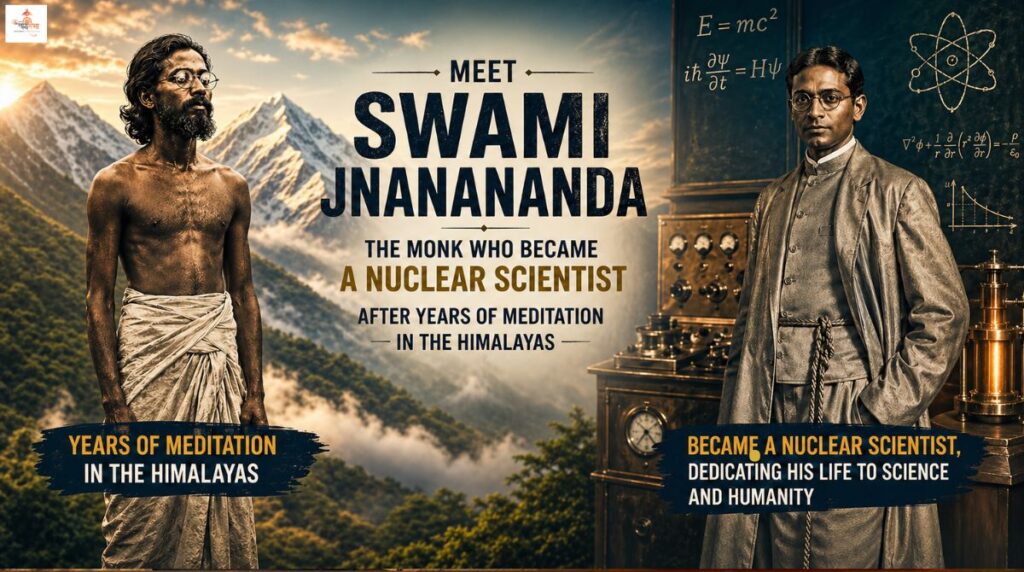
In the freezing silence of a Himalayan cave, a saffron-robed monk sat motionless for years, lost in deep meditation. He had renounced everything family, comfort, and worldly ambition. Then, one day, he stepped out of that cave and walked into the world of atoms, laboratories, and cutting-edge nuclear physics.
What makes this story astonishing is not that he became a scientist but that he became an outstanding one, earning advanced degrees in Europe and America, working with Nobel laureates, and building India’s pioneering university nuclear research department all while wearing the same saffron robes.
Swami Jnanananda’s life is a rare and beautiful rebellion against the idea that spirituality and science must remain enemies. From the snow-covered peaks of Gangotri to the lecture halls of Dresden and the laboratories of Liverpool and Michigan, he showed that the deepest inner silence can fuel the sharpest outer discovery.
This is the extraordinary journey of a monk who proved that the cave and the laboratory are not opposites they are two doorways to the same ultimate truth.
Born Bhupathiraju Lakshminarasimha Raju in 1896 in a small Andhra Pradesh village, he felt an early pull toward the spiritual path. Inspired by the life of Buddha, he left home at 21, wandered pilgrim centers, and dove deep into Himalayan solitude. There, through yoga and meditation, he touched profound inner peace and wrote Purna Sutras, his vision of complete knowledge. Yet life had another chapter waiting. A chance encounter reignited his boyhood love for science. With his guru’s blessing, he stepped into classrooms and laboratories across Germany, Czechoslovakia, England, and the United States. He earned advanced degrees, worked alongside Nobel laureates, and pioneered research in X-ray spectroscopy and nuclear physics.
Swami Jnanananda never saw a conflict between his monk’s robe and the scientist’s lab coat. For him, both paths revealed the same truth: the universe’s deepest secrets live inside us and around us. His story reminds us that discipline, curiosity, and inner stillness can lead to breakthroughs that change lives and nations. In a world that often forces us to choose between faith and reason, his life shows they can dance together beautifully.
“In the silence of the caves, I found the universe within. Science showed me its dance in every particle.” “True knowledge has no boundaries. It flows from the heart as much as from the mind.”
Early Life and the Call to Renunciation
Swami Jnanananda grew up in Goraganamudi, a serene village near Bhimavaram in the West Godavari district of Andhra Pradesh. Born on December 5, 1896, as Bhupathiraju Lakshminarasimha Raju, he was the eldest son of Bhupathiraju Rama Raju and Sita Devi. The family belonged to a Kshatriya lineage tracing back to ancient seers like Viswamitra. His father, a wealthy and respected landlord, owned vast rice fields and beautiful fruit gardens. Rama Raju was also a Vedic scholar who filled their home with a rich collection of ancient scriptures, philosophical texts, and the Bhagavad Gita.
From a young age, young Lakshminarasimha showed a sharp and curious mind. He began his education at home under a private tutor, Brahmasri Mangipudi Veerayya Siddanti, a learned pundit and close friend of his father. At age five, he started formal learning that blended traditional knowledge with basic academics. Later, he joined Taylor High School in Narasapuram (and briefly Bhimavaram). While he excelled in mathematics, physics, and chemistry, he struggled with other subjects and could not clear his S.S.L.C. examination in 1917. This academic setback, however, did not discourage him. Instead, it quietly steered him toward deeper questions about life and truth.
The family home buzzed with spiritual discussions. His father’s library became a treasure trove where the boy spent countless hours reading. Stories from the epics, the lives of saints, and especially Edwin Arnold’s The Light of Asia a poetic account of Gautama Buddha’s journey touched him profoundly. He saw in Buddha a mirror of his own inner longing: a call to seek truth beyond comfort and worldly success.
Life at home seemed comfortable. In 1916, when he was about 20, his father arranged his marriage, hoping it would ground him in family responsibilities. But the spark of renunciation had already ignited. The young man felt increasingly restless. He practiced simple meditation and yoga in secret, drawn by an inner voice that whispered of a larger purpose. Family members noticed his growing detachment but tried to pull him back into normal life.
One quiet night in December 1917, on December 14 or 21 according to different accounts, everything changed. Without informing anyone, 21-year-old Lakshminarasimha left home with just a few rupees, a blanket, a spare shirt, and the clothes he wore. He walked through the night and boarded a train heading north. At Tuni station, spotting familiar faces, he slipped off the train and continued on foot to avoid being stopped. His destination was Lumbini in Nepal, the birthplace of Buddha. He carried no grand plan, only a burning desire to follow the path of renunciation.
The journey tested him immediately. He walked long distances, crossed rivers, and survived on whatever fruits and roots he could find. In Nepal’s forests, malaria struck hard. Fever left him weak and alone. Yet even in suffering, he continued simple breathing practices and meditation. A compassionate man named Yudda Vikramark found him in Mujaffarpur, took him home, and nursed him back to health. This kindness renewed his strength. He pressed forward, visiting sacred pilgrim centers across northern India for nearly a decade, learning from saints, studying Vedic texts, and deepening his inner practice.
His family searched for him and tried to persuade him to return. Letters and messengers reached him, but his resolve remained firm. He gently explained that his path was one of self-discovery and service to truth, not tied to worldly duties. By 1918, he stood at the foothills of the mighty Himalayas, ready for the intense sadhana that would shape the rest of his extraordinary life.
Even in those early wandering years, glimpses of his future balance appeared. While helping students in a small town with physics problems, his old love for science flickered again. Yet the spiritual call rang louder. He chose the path of complete surrender, trusting that the same divine intelligence guiding the stars would also guide his steps.
“Renunciation is not giving up the world. It is discovering the Self that never changes.” “I left home not to run away, but to run toward the light I felt calling from within.” “The scriptures in my father’s library planted the seeds. Buddha’s life watered them. The Himalayas would make them bloom.”
This early chapter of Swami Jnanananda’s life reveals a beautiful truth: sometimes the greatest journeys begin with a single, courageous step into the unknown. His youthful courage and deep inner calling prepared him perfectly for the decade of Himalayan transformation that lay ahead.
Himalayan Sadhana – A Decade of Meditation, Yoga and Self-Realization
The mighty Himalayas became Swami Jnanananda’s true university, a living classroom of silence, endurance, and awakening. From around 1918 to 1927, he immersed himself completely in rigorous spiritual practice. He moved between remote caves, simple cottages, and sacred ashrams in places like Rishikesh, Mount Abu, Uttarkashi, Kashmir, and the high altitudes of Gangotri. These years tested every limit of body and mind, yet they gifted him unshakable inner strength and profound realizations.
He lived with extreme simplicity. Often wearing only a loincloth or practicing as a Digambara yogi completely sky-clad he faced freezing temperatures, blizzards, and wild animals without fear. Through advanced pranayama (breath control) and intense hatha yoga, he generated inner heat that protected him from the cold. He mastered challenging asanas such as Padmasana, Siddhasana, and Paschimottanasana. He could sit motionless for many hours, withdrawing his senses in pratyahara, concentrating deeply in dharana and dhyana, and entering exalted states of samadhi.
In Rishikesh, he found his spiritual home at Swargashram on the banks of the holy Ganga. He stayed in cottage number 126, next to his guru, Swami Purnananda (formerly Saraschandraji). The guru recognized the young seeker’s advanced state and formally initiated him into sannyasa around 1921. He received the name Swami Jnanananda, meaning “one who finds bliss in knowledge.” Their bond was deep and transformative. Daily life followed a strict rhythm: early morning asanas, long sessions of pranayama, meditation, study of Vedic texts, and service to fellow sadhakas.
Swami Jnanananda described beautiful inner experiences during these years. In savikalpa samadhi, he felt the living presence of Lord Krishna as a dear friend, full of love and guidance. In deeper nirvikalpa samadhi, the sense of “I” dissolved completely into pure awareness and cosmic unity. In the caves and waterfalls of Kashmir, he practiced jalastambhana remaining underwater for extended periods while holding his breath. These practices sharpened his will and opened new dimensions of consciousness.
One of the most creative periods came in 1925-26 at Santi Guha (the Cave of Peace) in Gangotri. There, in the icy solitude near the source of the Ganga, he composed his major philosophical work, Purna Sutras. Written in poetic verses, this text captured his realizations on complete knowledge, the nature of time and space, non-dual reality, and the unity of all existence. It blended insights from Raja Yoga, Vedanta, and his direct experiences, offering a practical path to self-realization.
His spirit of adventure and surrender shone brightly during a memorable pilgrimage to Mount Kailash. Walking as a Digambari yogi, naked in the snow and high mountain passes, he felt no cold. Devotees who witnessed his journey called him Digambari Yogi in awe. He also visited sacred sites like Gomukh, Badrinath, and Uttarkashi, often leading small groups of seekers.
These years were not without hardship. Malaria returned, hunger tested his faith, and isolation brought moments of doubt. Snow leopards roamed nearby, and fierce storms sometimes trapped him in caves. Yet each challenge deepened his trust in divine grace. He later reflected that the stillness of the mountains trained his mind with the same laser-like focus he would later bring to scientific research.
By the mid-1920s, Swami Jnanananda had achieved profound self-realization. He had touched the unity of existence that sages speak about. The inner light he discovered in those Himalayan caves would guide every future step whether in lecture halls, laboratories, or back in his motherland.
“In the cave’s silence I lost my body and found the cosmos.” “Yoga showed me that the same energy flowing through my breath moves the stars.” “Samadhi is not escape. It is waking up to the truth that was always there.” “The Himalayas did not just test me. They refined me, preparing my mind to explore both the atom and the Atman with equal wonder.”
The Turning Point – From Caves to Classrooms
This decade of intense sadhana forged Swami Jnanananda into a rare being a realized soul whose inner mastery would soon meet the outer world of science. The mountains had done their work. A new chapter was ready to unfold.
After nearly a decade of profound Himalayan sadhana, Swami Jnanananda felt a gentle inner pull to return to the plains. In late 1926 or early 1927, he came back to his native village of Goraganamudi. The saffron-robed monk, now deeply realized, began sharing his wisdom through public lectures on Vedanta, yoga, and his newly completed Purna Sutras. Crowds gathered to hear him compare Eastern philosophy with Western thought, especially on concepts like time and space.
During this homecoming, a simple yet life-changing moment occurred. One morning, while resting on the steps of a house where he was staying, Swami Jnanananda overheard a group of college students struggling with a difficult physics problem from their textbook. The young men discussed it heatedly in the sunlight, unable to find the solution. Something stirred in him his boyhood love for science, long dormant amid intense spiritual practice, suddenly awakened.
Without revealing much about himself, he asked to see the problem. On a piece of paper, he wrote a clear, step-by-step solution and handed it to the surprised students. Word spread quickly through the small town that a mysterious monk could solve advanced physics questions with ease. The students returned with more doubts, and soon he was informally tutoring them. This interaction rekindled a deep joy he had not felt in years. He realized that spiritual insight and scientific curiosity were not opposites but complementary paths to the same truth.
His father, Rama Raju, observed this spark with great interest. Impressed by his son’s lectures on Purna Sutras and his natural command over scientific ideas, he made a bold suggestion: “Why not travel to Germany? You can share your yogic wisdom and philosophical views there, and also learn what Western thinkers and scientists have to say.” In those pre-independence days, such a journey seemed almost impossible for an ordinary Indian. Yet, with his guru Swami Purnananda’s blessings and some divine help, the opportunity opened up.
In 1927, Swami Jnanananda set sail for Europe, carrying manuscripts of Purna Sutras for printing and a heart full of quiet determination. His initial plan was to deliver spiritual discourses and introduce Indian mysticism to Western audiences. In Dresden, Germany, his lectures on yoga, meditation, and the philosophy of complete knowledge drew large, enthusiastic crowds. He gave over 150 talks during this period, touching many lives with his calm presence and profound insights.
One lecture on “Time and Space” particularly caught the attention of Professor Dember at the College of Science and Technology, Dresden University. Professor Dember attended the monk’s talk and was deeply impressed. In return, he invited Swami Jnanananda to his lectures on Einstein’s theory of relativity. The Swami found these ideas fascinating, yet he realized his mathematical background needed strengthening to grasp them fully. With Professor Dember’s encouragement, he decided to enroll as a student.
Despite having no formal degree beyond high school, Swami Jnanananda took the entrance examinations and cleared them brilliantly. He completed a rigorous four-year undergraduate course in mathematics and physics in just two years, by 1929. The saffron-robed monk became a familiar and respected figure on campus attending lectures by day, meditating and maintaining his simple discipline by night.
This period marked a beautiful turning point. The years of Himalayan silence had sharpened his mind like a razor. What once seemed like two separate worlds the inner realm of spirit and the outer realm of science now began to merge seamlessly. Einstein’s relativity resonated with his own realizations about the nature of reality. He saw how modern physics could illuminate some of the subtle energies and phenomena yogis experience in deep meditation.
“Helping those students solved more than their problems. It solved the direction of my life.” “Science and spirituality are two eyes of the same seeker.” “I entered the classroom not to leave the cave behind, but to bring its light into the world of atoms and equations.”
The monk who had once sat motionless in snow-covered caves now sat attentively in lecture halls. This harmonious blend of inner realization and outer knowledge would define the rest of his remarkable journey, proving that true wisdom knows no boundaries.
Academic Foundations in Europe
Swami Jnanananda’s European years marked a remarkable bridge between ancient Himalayan wisdom and modern scientific inquiry. Arriving in Germany in 1927 with the primary aim of printing Purna Sutras and delivering spiritual lectures, he soon found himself drawn deeper into the world of academia. What began as an opportunity to share Indian philosophy quickly evolved into a rigorous pursuit of knowledge that would shape the rest of his life.
In Dresden, at the College of Science and Technology, he enrolled as a student despite limited formal qualifications. He immersed himself in mathematics, theoretical physics, and experimental physics. Professor Dember, impressed by the monk’s sharp intellect and calm presence during lectures on Einstein’s theory of relativity, became a key mentor. Swami Jnanananda completed a demanding four-year program in just two years, balancing intense studies with his daily spiritual discipline. He continued giving over 150 public talks on yoga, Vedanta, and Purna Sutras, often wearing his saffron robes, which made him a distinctive figure on campus.
As political tensions rose in Germany in the early 1930s, Swami Jnanananda moved to Prague, Czechoslovakia. There, at the prestigious Charles University, he joined the research group of Professor Dolshek. For about three years, he focused on high-tension electricity and X-ray physics. His pioneering experimental work led to the development of precise new methods in X-ray spectroscopy techniques that allowed scientists to study atomic structures and radiation with greater accuracy than before.
In July 1936, Charles University awarded him the Doctor of Science (D.Sc.) degree for his outstanding research. This achievement was remarkable not only for its scientific merit but also because it came from a saffron-robed monk who had spent years in Himalayan caves. His colleagues admired his extraordinary concentration, attributing it to the mental discipline honed through years of meditation and pranayama. Swami Jnanananda often remarked that the stillness he cultivated in the mountains helped him maintain focus during long, delicate laboratory experiments.
Throughout his European stay, he lived simply eating modest meals, meditating early each morning, and maintaining strict celibacy and ethical discipline. This balance earned him deep respect. He never saw science as separate from spirituality. Instead, he viewed laboratory work as a continuation of his sadhana, where precision in measurement mirrored precision in inner observation.
When the clouds of World War II gathered and political instability intensified, he shifted to England. Yet the foundation built in Germany and Czechoslovakia proved invaluable. Those years equipped him with world-class training, a global scientific network, and the confidence that a realized soul could excel in the most rigorous intellectual fields.
“The lab became my new cave. Experiments became my meditation.” “Inner stillness sharpens the intellect like a razor. What the Himalayas gave me, the university helped me apply.” “I did not leave spirituality to study science. I took the light of the caves into the lecture halls and laboratories.”
These European academic foundations transformed Swami Jnanananda from a Himalayan yogi into a fully trained scientist. They prepared him perfectly for the groundbreaking research that would follow in England and America, and for the service he would later offer to his motherland. The monk had shown the world that true knowledge flows seamlessly from the silence within to the discoveries without.
Breakthroughs in Nuclear Physics – UK and USA
The outbreak of World War II pushed Swami Jnanananda into the heart of cutting-edge nuclear research. As Europe grew unstable, he moved to England and joined the University of Liverpool, one of Britain’s premier centers for atomic studies. There, under the guidance of Sir James Chadwick the Nobel laureate who discovered the neutron in 1932 he immersed himself in nuclear physics.
Swami Jnanananda focused on beta radiation spectroscopy, a specialized field that examines the energy distribution of electrons emitted during radioactive decay. This work was crucial for understanding the internal structure of the atomic nucleus. Working in Chadwick’s laboratory during the tense war years (roughly 1940–1943), he designed and used advanced instruments like thick magnetic lens beta-ray spectrographs. His precise experiments and theoretical contributions earned him a Ph.D. from the University of Liverpool in 1943. His dissertation, Thick Magnetic Lens β-ray Spectrograph Theory and Application, became a notable reference in the field.
Even amid wartime challenges including air raids and resource shortages the saffron-robed monk maintained his calm discipline. Colleagues were amazed by his focus and ethical commitment. He continued his simple lifestyle, meditating early in the morning before heading to the lab. For him, studying the secrets of the atom was another form of worship revealing the same divine intelligence he had experienced in Himalayan samadhi.
When research conditions in war-torn Britain became difficult, Swami Jnanananda moved to the United States in 1944–45. He joined the University of Michigan in Ann Arbor, invited by Professor Lindsay, an eminent physicist. At Michigan, he continued his beta-ray spectroscopy research using a wider range of radioactive isotopes. This allowed deeper insights into nuclear behavior and decay processes. He published several papers in reputed journals like Physical Review, covering topics such as the beta radiations of elements like Uranium X, Antimony, Tantalum, Tungsten, and Iridium.
During his American years, he also completed and published his important book, High Vacua: Principles, Production, and Measurement (Van Nostrand, 1947). This 310-page work became a valuable resource for experimental physicists. High-vacuum techniques are essential in nuclear research because they remove air molecules that could interfere with precise measurements of particles and radiation. His practical guidance helped improve laboratory equipment and experimental accuracy worldwide.
Throughout these years, Swami Jnanananda remained deeply spiritual. He saw no conflict between probing the nucleus and realizing the Atman. In lectures and writings, he often noted how the elegant order within atoms mirrored the cosmic order he had witnessed in meditation.
“The nucleus holds secrets just as the soul holds truth. Both reveal the same intelligence.” “Precision in experiment mirrors precision in meditation. Both lead to discovery.” “I entered the laboratory wearing the same robe I wore in the caves, for both places taught me the same lesson: surrender to truth.”
His breakthroughs in beta spectroscopy and high-vacuum technology advanced the broader understanding of nuclear forces and paved the way for future applications in energy and medicine. More importantly, they proved that a life rooted in Himalayan stillness could produce world-class scientific contributions. By the time India gained independence in 1947, Swami Jnanananda was ready to bring this rare blend of knowledge back home to serve his nation.
Return to India – Building National Scientific Institutions
India’s independence in 1947 filled Swami Jnanananda with deep joy and renewed purpose. After nearly twenty years abroad, he returned home in 1948 and joined the National Physical Laboratory (NPL) in Delhi as a senior scientific officer. There, he helped lay the foundation for India’s early nuclear research infrastructure.
In April 1954, while visiting his village, he met with a serious accident and was treated in Visakhapatnam. During recovery, the Vice-Chancellor of Andhra University, V.S. Krishna, invited him to build a strong nuclear physics program. Swami Jnanananda accepted this as a divine call to serve his motherland.
He joined as the Gautami Professor on October 15, 1954. On July 1, 1956, Andhra University established a separate Department of Nuclear Physics one of the first in Indian universities outside government atomic programs. Swami Jnanananda became its Professor and Head.
He worked with total dedication, setting up modern laboratories for radiation studies and experimental nuclear physics. He trained students rigorously, guided over twenty doctoral scholars, and published important research papers. The university honored his contributions by naming the facility the Swami Jnanananda Laboratories of Nuclear Research. He served as Head until 1965 and later as Emeritus Professor until his passing in 1969.
Even as a top scientist, he lived simply in saffron robes, with the same discipline he had practiced in the Himalayas. Students cherished his calm guidance and his unique ability to blend scientific excellence with spiritual wisdom.
“Science grows best when it is rooted in discipline and service.”
Swami Jnanananda’s return beautifully embodied the true spirit of renunciation using all his knowledge for national upliftment. The monk from the Himalayas had come full circle, building institutions that continue to inspire both scientists and seekers today.
Details on the Nuclear Physics Department
The Department of Nuclear Physics at Andhra University is recognized as a pioneering academic center in India, focused exclusively on advanced-level teaching and research in nuclear physics. Under Swami Jnanananda’s visionary leadership, it quickly grew into a hub of excellence.
He designed and established modern laboratories equipped for radiation studies, beta-ray spectroscopy, nuclear spectroscopy, and experimental nuclear physics. He procured advanced equipment, often leveraging his international connections from Europe and the USA. The department introduced rigorous experimental training programs and fostered a strong research culture that combined theoretical depth with hands-on precision.
Key achievements during and after his tenure include:
- Guiding more than 20 doctoral scholars (many earning Ph.D. and D.Sc. degrees).
- Producing over 100 research papers in reputed journals.
- Publishing influential books such as The Elements of Nuclear Physics (1962) and Nuclear Models (1975, posthumously).
- Establishing research areas in nuclear spectroscopy, nuclear reactions, interaction of gamma radiation, and applied aspects like radiation oncology.
In recognition of his extraordinary contributions, the university named the facility the Swami Jnanananda Laboratories of Nuclear Research. The department stands out as one of the few university-based nuclear physics centers in India not directly under the Department of Atomic Energy, making it an important independent academic institution.
Swami Jnanananda served as Professor and Head until 1965. After retirement, the university appointed him Emeritus Professor, a position he held with honor until his passing in 1969. Andhra University later erected a statue and a bust in his memory. Alumni gatherings and annual tributes continue to honor his legacy, with former students remembering his calm guidance and ability to blend scientific rigor with spiritual wisdom.
Throughout these years, Swami Jnanananda lived exactly as he had in the Himalayas in simple saffron robes, with minimal needs and maximum focus. Students and colleagues recall his ethical standards, deep concentration, and unique way of connecting complex physics concepts with deeper philosophical truths. He proved that true leadership combines technical excellence with inner strength and selfless service.
“Science grows best when it is rooted in discipline and service. The Himalayas taught me both.” “Building these laboratories was like constructing another cave a sacred space where young minds could discover the secrets of creation.”
Swami Jnanananda’s return to India demonstrated the true spirit of renunciation: using all acquired knowledge not for personal glory but for national upliftment. He helped lay a strong academic foundation for nuclear science in Indian universities, creating a legacy that continues to inspire scientists and seekers alike. The monk had come full circle from Himalayan silence to serving a free India through both wisdom and dedicated work.
The Philosopher-Scientist – Bridging Spirituality and Science
Swami Jnanananda never saw any conflict between his saffron robe and the scientist’s lab coat. For him, spirituality and science were not opposing forces but two complementary wings of the same bird both seeking the same ultimate truth. He lived and taught this harmony with rare grace, becoming a true philosopher-scientist of modern India.
Throughout his life, he moved effortlessly between two worlds. In the mornings, he would meditate in silence. In the laboratory, he would conduct precise experiments on beta radiation or high-vacuum systems. He wrote authoritative textbooks on nuclear physics and high-vacuum technology, while simultaneously authoring profound works on Vedanta, Raja Yoga, and the unity of science and religion. His masterpiece, Purna Sutras, written in the Himalayas, already hinted at this bridge. It presented Purna Jnana complete knowledge that integrates inner realization with outer discovery.
In his lectures at Andhra University, students were fascinated by his unique style. He could explain the structure of the atomic nucleus and then gently connect it to the Vedantic concept of the Atman (the inner Self). He often said that the same intelligence that governs the laws of physics also reveals itself in the depths of meditation. Yogic experiences of inner light and energy, he explained, find echoes in Einstein’s relativity and the subtle realities of quantum behavior.
Swami Jnanananda believed science without spirituality becomes dry and potentially dangerous, while spirituality without scientific temper can become superstitious. Science gives spirituality rigor, clarity, and practical tools. Spirituality gives science ethical direction, inner strength, humility, and a sense of wonder. He lived this balance daily maintaining strict monastic discipline even while heading a university department and publishing research papers.
His philosophy was beautifully captured in the idea of Purna Yoga a complete path that does not force a choice between the cave and the classroom. For him, both were sacred spaces for discovering truth. The focus he developed during years of Himalayan meditation helped him concentrate for long hours in the lab. Similarly, the precision required in nuclear physics sharpened his inner observation during meditation.
Even in casual conversations with students, he would say simple yet profound things: the atom is not just a physical particle it is a dance of energy expressing the same divine order one experiences in samadhi.
“The atom and the Atman are not different. Both are expressions of the One.” “Curiosity without compassion is empty. Stillness without inquiry is incomplete.” “True knowledge has no boundaries. It flows from the silence of the cave as naturally as from the precision of the laboratory.”
Swami Jnanananda’s life stands as a powerful model for our times. In an age that often tries to separate faith and reason, he showed they can support and enrich each other. He proved that a deeply spiritual person can be an outstanding scientist, and a rigorous scientist can live with the serenity of a monk.
His rare integration continues to inspire young scientists, spiritual seekers, educators, and thinkers who refuse to live divided lives. He showed that the greatest discoveries whether of the inner Self or the outer universe begin with the same qualities: deep stillness, sharp observation, relentless curiosity, and humble surrender to truth.
The philosopher-scientist had truly become whole. In him, the Himalayas and the laboratory spoke with one voice.
Enduring Legacy and Relevance Today
Swami Jnanananda left his physical body on September 21, 1969, at the age of 72. Yet more than five decades later, his inspiring life and integrated vision continue to shine brightly across India and beyond.
At Andhra University in Visakhapatnam, the Swami Jnanananda Laboratories of Nuclear Research remains a living tribute. The department he founded in 1956 still functions actively, training students and conducting research. A dignified statue and bust of the saffron-robed scientist stand on campus, reminding every passing student of the rare harmony between spirituality and science. Former students and research scholars often speak with deep respect about his calm guidance, ethical standards, and ability to make complex physics feel sacred.
His influence extends far beyond one university. Many of his doctoral scholars became distinguished professors, scientists, and leaders in research institutions across the country. His books on nuclear physics and high-vacuum technology are still referenced, while Purna Sutras and his philosophical writings continue to be studied in spiritual circles, especially in Telugu and Hindi-speaking communities.
In today’s fast-changing world, Swami Jnanananda’s message feels more relevant than ever. Young people face intense pressure to choose between career success and inner peace. His life offers a powerful alternative: you do not have to sacrifice one for the other. In an age of artificial intelligence, climate crises, and widespread mental health challenges, his example shows the immense value of inner balance. Meditation builds unbreakable focus and emotional resilience. Scientific thinking brings clarity and problem-solving ability. When combined, they create leaders who serve society with both wisdom and compassion.
Schools, colleges, and spiritual organizations now regularly share his story through lectures, books, and youth programs. Many modern seekers scientists, doctors, engineers, and students draw inspiration from his journey. They see in him proof that ancient Himalayan wisdom can beautifully support cutting-edge discovery and ethical progress.
Swami Jnanananda’s legacy is not limited to buildings, statues, or books. It lives in every person who dares to bridge the inner and outer worlds who meditates in the morning and works with integrity in the laboratory or office, who seeks truth without losing compassion.
“Legacy is not in buildings or books alone. It lives in every seeker who dares to bridge two worlds.” “The greatest service one can offer is to live as a complete human being spiritually awake and scientifically awake.” “In silence we find the light. In inquiry we share it. Both are sacred.”
Today, as humanity stands at the crossroads of rapid technological growth and deep spiritual hunger, Swami Jnanananda’s life offers a clear, uplifting path forward. He reminds us that the future belongs not to those who choose sides, but to those who integrate heart and head, cave and classroom, ancient wisdom and modern knowledge into one beautiful wholeness.
His enduring message is simple yet profound: Become whole. Seek truth fearlessly. Serve humanity with love. In that integrated life lies the real success and lasting peace the world needs most.
Exploring the Philosophy of Purna Sutras by Swami Jnanananda
Purna Sutras stands as Swami Jnanananda’s masterpiece a profound collection of around 560 concise aphorisms (sutras) composed during his intense Himalayan sadhana, particularly in the Santi Guha (Cave of Peace) at Gangotri in 1925-26. Written in a style modeled after the ancient Brahma Sutras, it offers a fresh, experiential foundation for complete (purna) knowledge. “Purna” here means wholeness, fullness, or perfection referring to the realization of the infinite, non-dual reality that encompasses everything without limitation.
Core Themes and Vision
Swami Jnanananda presents Purna Yoga a holistic path that integrates Raja Yoga, Vedanta, and direct inner realization. Unlike purely theoretical texts, the sutras flow from his samadhi experiences. They emphasize:
- Unity of Existence (Advaita Reality): All phenomena time, space, matter, and consciousness arise from and dissolve into one indivisible whole. The sutras explore how the apparent diversity of the universe is a play within the singular Brahman or Pure Awareness.
- Complete Knowledge (Purna Jnana): True wisdom is not fragmented (partial science or partial spirituality) but total. It bridges inner subjective experience with outer objective reality. This foreshadows Swami Jnanananda’s later life, where meditation and nuclear physics became two expressions of the same quest.
- Practical Sadhana and Self-Realization: The text provides a step-by-step roadmap through yoga’s eight limbs (ashtanga), advanced meditation techniques, and transcendence of ego. It describes states like savikalpa and nirvikalpa samadhi, where the practitioner moves from personal bliss to complete dissolution of duality.
- Harmony of Science and Spirituality: Even in the 1920s, Swami Jnanananda hinted at parallels between yogic insights into energy and modern physics concepts like relativity (time-space) and quantum unity. He viewed the atom and the Atman as reflections of the same underlying intelligence.
- Universal Spirituality: The sutras transcend narrow religious boundaries, offering a philosophy accessible to seekers from all traditions. They stress ethical living, inner purity, and service as natural outcomes of realization.
The work is poetic yet precise brief aphorisms that “express and expose the essential facts” of existence, much like ancient Vedic sutras. It was first printed in Germany in 1928 during his lectures, where it impressed Western audiences with its clarity and depth.
Key Insights from the Sutras
Though the full English translation remains somewhat limited in public circulation (original primarily in Telugu with Hindi versions), discourses by scholars like Dr. B. Ramaraju highlight its chapters covering:
- Foundations of complete knowledge.
- Nature of time, space, and causality.
- The path beyond mind and intellect.
- Realization of Purna Swarajya (perfect inner freedom).
One recurring message: The universe is within you. By turning inward through disciplined practice, one discovers the same laws governing stars, atoms, and consciousness. This “new foundation for holistic existence” integrates body, mind, and spirit into a seamless whole.
Relevance Today
In an era of specialization, Purna Sutras offers a refreshing reminder that the deepest truths emerge at the intersection of disciplines. For spiritual seekers, it provides practical guidance toward self-realization. For scientists and thinkers, it invites wonder about consciousness and the limits of materialism. For everyone, it inspires a balanced life disciplined yet joyful, rooted yet expansive.
Swami Jnanananda lived this philosophy. The same focus that sustained him through Himalayan blizzards later drove precise experiments in beta-ray spectroscopy. His sutras are not mere words but living invitations: Become whole. Know the Purna.
“Purna is not addition. It is the recognition that nothing was ever missing.”
Exploring Purna Yoga Practices
Purna Yoga, as presented in Swami Jnanananda’s Purna Sutras, is a holistic, integrative path to Purna Jnana (complete knowledge) and self-realization. It is not a rigid new system but a complete (purna) approach that draws from classical yoga while adapting it to individual temperaments and the modern age. It integrates inner realization with outer knowledge, including scientific inquiry, making it uniquely suited for seekers who want both spiritual depth and practical wholeness.
Core Vision of Purna Yoga
Purna Yoga aims for the refinement of the nervous system and mind (chitta) to enable spontaneous transitions to higher states of consciousness ultimately to the ground state of pure awareness (turiya or transcendental consciousness). It views the human nervous system as capable of supporting all levels of consciousness: waking, dreaming, deep sleep, and the transcendent.
The path emphasizes:
- Removing stresses and agitations (vrittis) that keep consciousness in excited states.
- Increasing sattva (purity and clarity) while balancing rajas (activity) and tamas (inertia).
- Experiencing waves of bliss that further refine the system until nirvikalpa samadhi becomes stable and one lives in constant awareness of the Divine.
The Four Yogic Paths in Purna Sutras
Swami Jnanananda outlines four yogic paths tailored to different human temperaments. Seekers should explore and choose what best fits their nature rather than forcing a single method. These paths induce the “refinement process” needed for self-realization:
- Paths suited to gradual refinement — Steady, step-by-step practices that slowly purify the mind and body.
- Intense, direct approaches — More vigorous methods for faster progress.
- Specialized techniques — Advanced practices like those Swami himself used (e.g., prolonged meditation leading to spontaneous samadhi).
- Integrated or spontaneous Purna Yoga — Combining elements for complete development, where realization flows naturally into daily life.
He stresses personalization: “Each individual should explore, choose and practice the particular Yoga technique that best fits one’s temperament.”
Key Practices in Purna Yoga
Purna Yoga builds on classical Raja Yoga but emphasizes direct experience over theory. Practices come directly from Swami Jnanananda’s own Himalayan sadhana:
- Asanas (Postures): Steady, prolonged sitting postures for meditation, especially Paschimottanasana (seated forward bend). Swami practiced this for 1.5 hours or more at a stretch, losing body consciousness and entering bliss states. Other classic asanas for physical preparation and inner heat generation (tapas).
- Pranayama (Breath Control): Intensive breath regulation to generate inner heat, calm the mind, and prepare for deep meditation. Practices like jalastambhana (breath retention underwater) in Kashmir caves and waterfalls.
- Dhyana (Meditation) and Samadhi: Long, uninterrupted meditation sessions leading to: Savikalpa Samadhi: Blissful experience with form (e.g., feeling Lord Krishna’s living presence). Nirvikalpa Samadhi: Complete dissolution of “I”-sense into pure awareness. Gradual stabilization so that transcendental awareness persists even in waking, dreaming, and deep sleep states (Brahmakara vritti or “I am Brahman” awareness).
- Refinement and Stress Release: Practices to reduce mental agitations and strengthen the nervous system. Ethical living, simplicity, and detachment as foundations. Service and knowledge-seeking (including science) as expressions of realization.
- Advanced and Experiential Elements: Extreme endurance: Living with minimal clothing (Digambara style) in Himalayan cold, fasting, and isolation. Pilgrimages (e.g., to Mount Kailash) as moving meditation. Writing or reflecting on realizations (Purna Sutras itself emerged from this).
Unique Features of Purna Yoga
- Fact-to-Fact Progression: Starts with observable facts (body, breath, mind) and extends to the Absolute ideal for scientifically minded seekers.
- No Conflict with Daily Life: Realization should shine through all activities, not just in caves.
- Bliss as Guide: Waves of bliss during transitions confirm progress and further purify the system.
- Universal and Integrative: Honors all valid paths while adding the dimension of complete knowledge (Purna Jnana).
“The refinement process involves altering the composition [of the mind] to increase the influence of Sattva… and enable the mind to transcend from the influence of all three gunas slowly by steady practice.” “Purna Yoga… consists of the restraint of vrittis, the transcendence over the sense-ego and the Super-ego, the realization of the absolute Divine.”
How to Practice Purna Yoga Today
Begin with sincere self-observation: Which path or practice resonates most? Start simply with daily asanas, pranayama, and meditation. Cultivate inner silence while engaging life fully. Study Purna Sutras and Swami’s autobiography for inspiration. Consistency, patience, and a living teacher (or inner guidance) are key.
Purna Yoga ultimately crowns the seeker with wholeness where the cave of the heart and the laboratory of the world become one sacred space. It invites you not just to practice yoga, but to become the living fullness you already are.
Conclusion and Final Reflections
Swami Jnanananda’s extraordinary path from Himalayan caves to nuclear laboratories offers a beautiful message. We do not have to choose between heart and head, spirit and science. With discipline, curiosity, and open-hearted surrender, we can walk both paths at once.
His life calls us to cultivate stillness amid busyness, to ask big questions, and to serve others with whatever gifts we have. Whether you meditate on a mountain or work in a lab, the same truth awaits: the universe is one, and we are part of its magnificent story.
Let his example light your way. Seek knowledge fearlessly. Hold inner peace tenderly. And remember, the greatest discoveries often begin in silence.
He walked the rarest of paths ten years in Himalayan caves, followed by decades in international laboratories and lecture halls and showed that both paths lead to the same divine intelligence dancing in every atom and every soul.
In a world that constantly pulls us toward extremes, his message rings clear and hopeful: become whole. Cultivate deep inner stillness and fearless outer curiosity. Let meditation sharpen your focus and science expand your wonder.
Whether you sit in meditation or work in a lab, the same sacred truth awaits you. The universe is not divided. And neither should we be.
Let Swami Jnanananda’s extraordinary life inspire you to bridge your own two worlds. The greatest discoveries, after all, often begin in silence and shine brightest when shared with the world.
The monk who left the cave never really left it. He simply carried its light into every corner of human knowledge.