
Imagine a universe where everything vibrates with life, where your very awareness helps shape what you see. This 10-page journey explores how ancient Indian wisdom from Advaita Vedanta, Kashmir Shaivism, and its Trika Darshana school echoes the strange wonders of quantum physics. We meet non-dual consciousness as the ground of reality, the cosmic pulse called Spanda that mirrors quantum fluctuations, and the observer who collapses possibilities into the world we know. Two brilliant Indian scientists, Jagadish Chandra Bose and Satyendra Nath Bose, show how Eastern insight fueled Western breakthroughs. Far from forcing proofs, this article celebrates lively parallels that spark wonder. Today these ideas invite us to rethink consciousness, science, and our place in a deeply interconnected cosmos. The road ahead blends ancient recognition with cutting-edge discovery, leaving us inspired to dance with the universe rather than merely observe it.
Picture this: centuries ago in a misty Himalayan cave, a sage sits motionless. He realizes the entire cosmos is the playful dance of one supreme consciousness, Shiva, whose every step creates and dissolves worlds. Fast-forward to a sterile modern lab. A physicist aims a beam of electrons at a screen. When no one watches, the electrons behave like waves spreading everywhere at once. The moment someone looks, they snap into particles following neat paths. Reality itself seems to change under the gaze of awareness.
These two scenes, separated by a thousand years and vast oceans of thought, whisper the same surprising truth: consciousness may not be a mere bystander to the universe. It could be woven into the fabric of existence. This article dives into that thrilling overlap. We explore how Advaita Vedanta’s radical non-dualism, Kashmir Shaivism’s vibrant Trika Darshana, and today’s quantum physics all point toward a living, aware cosmos. No forced proofs here, just a celebration of ideas that light up the mind like fireflies on a summer night.
We will unpack the ancient philosophies first, then the key quirks of quantum theory. Next comes the heart of the story: where they meet in dazzling ways. We spotlight two Indian pioneers, the Bose brothers in spirit, whose work bridged East and West. Finally, we consider what this meeting means for us today and where it might lead. Get ready for a journey that feels both timeless and brand new, filled with wonder at how an ancient dance still echoes in the quantum waves all around us.
Shiva’s Eternal Pulse: The Philosophical Foundations of Advaita Vedanta and Kashmir Shaivism (Trika Darshana)
Long before telescopes or particle accelerators, Indian sages asked the deepest questions. What is real? Who am I? Their answers form two powerful non-dual traditions that still feel fresh today.
First, Advaita Vedanta, which simply means “not two.” This school, rooted in the ancient Upanishads, teaches that only one reality exists: Brahman, the infinite, unchanging consciousness. Everything else, the mountains, the stars, even our individual selves, appears separate because of Maya, a kind of cosmic illusion. Think of Maya like a beautiful dream. While you are dreaming, the dream world feels completely real. When you wake up, you see it was all one mind playing tricks. In the same way, Advaita says your true self, the Atman, is not different from Brahman. “Tat Tvam Asi,” the scriptures declare, “You are That.”
The great teacher Adi Shankara explained this with simple analogies. A rope lying in dim light might look like a snake and scare you. Once you bring a lamp closer, you see it was always just a rope. Likewise, once ignorance lifts, you recognize the world as Brahman alone. No separate creator, no separate creatures, just one seamless whole. This view feels peaceful and vast, like staring at the night sky and sensing you are made of the same stuff as the stars.
Kashmir Shaivism, especially its Trika Darshana or “threefold” system, takes this non-dualism and adds a joyful heartbeat. Developed between the 8th and 11th centuries in the Kashmir valley, it honors Shiva not as a distant god but as pure, dynamic consciousness. The universe is Shiva’s own playful self-expression.
At the center stands Spanda, the divine vibration or throb. Consciousness is never static. It pulses, expands, and contracts like a cosmic heartbeat. This vibration gives rise to everything through Shiva’s energy, called Shakti. The Trika system speaks of 36 tattvas, or levels of reality, unfolding from pure awareness down to the physical world we touch. Yet none of it is ever separate from Shiva.
A key practice is Pratyabhijna, the recognition of your own divine nature. You do not need to escape the world. You wake up inside it and see that every experience is Shiva playing hide-and-seek with himself. Abhinavagupta, one of the tradition’s greatest masters, described this as a festival of awareness where subject, object, and the knowing between them all melt into one joyful dance.
Where Advaita emphasizes the still, infinite ground of Brahman, Trika celebrates the lively play. Both reject the idea of a dead, mechanical universe. Both place consciousness front and center. They feel like two sides of the same glowing coin: one quiet and vast, the other vibrant and pulsing. Together they paint a picture of reality as alive, aware, and intimately connected to every one of us.
The Quantum Mystery Unveiled: Key Concepts in Modern Physics
Now let us step into the lab where things get wonderfully strange. Quantum physics studies the tiniest building blocks of nature, atoms, electrons, photons, and the rules they follow. These rules break our everyday expectations in beautiful ways.
Start with superposition. A quantum particle can exist in many possible states at once, like a spinning coin that is somehow both heads and tails until you catch it. The famous double-slit experiment shows this perfectly. Fire electrons at a barrier with two slits. If you do not watch which slit they take, they create an interference pattern on the other side, as if each electron went through both slits like a wave.
Then comes the observer effect, or measurement problem. The moment you try to measure which slit the electron uses, the interference vanishes. It behaves like a solid particle again. Suddenly reality seems to “choose” a definite path when observed. Scientists still debate exactly what counts as an “observer.” Is it the measuring device? A conscious mind? The debate itself is part of the wonder.
Next is entanglement. When two particles interact, they can become linked so that whatever happens to one instantly affects the other, no matter how far apart they are. Einstein called it “spooky action at a distance.” Yet experiments confirm it again and again. The universe behaves as if distance and separation are not as real as they seem.
Add the uncertainty principle from Werner Heisenberg. You cannot know both a particle’s exact position and its exact speed at the same time. The more precisely you pin down one, the fuzzier the other becomes. Reality has a built-in fuzziness.
Finally, quantum field theory reveals that even empty space bubbles with energy. Virtual particles pop in and out of existence in a constant dance. The vacuum is not empty. It vibrates with potential.
These ideas feel counter-intuitive, yet they power our phones, computers, and medical scanners. They also invite us to ask bigger questions. What if the universe is not a giant machine but a living, participatory show? Quantum physics does not hand us answers about consciousness, but it opens the door wide and leaves us wondering.
Where Ancient Wisdom Meets the Quantum World
Here is where the magic happens. Ancient sages and modern physicists seem to be describing the same dazzling reality from different windows.
Consider the observer who changes everything. In quantum labs the act of measurement collapses the wave function, turning fuzzy possibilities into solid facts. In Advaita Vedanta and Trika, consciousness is not a passive mirror. It is the very ground that brings the world forth. The sage who recognizes “I am Brahman” sees the universe arise within awareness, just as the quantum wave function seems to resolve when observed. No one claims the ancient texts predicted particle physics, yet the parallel feels electric. Both traditions suggest awareness plays an active role in shaping what appears real.
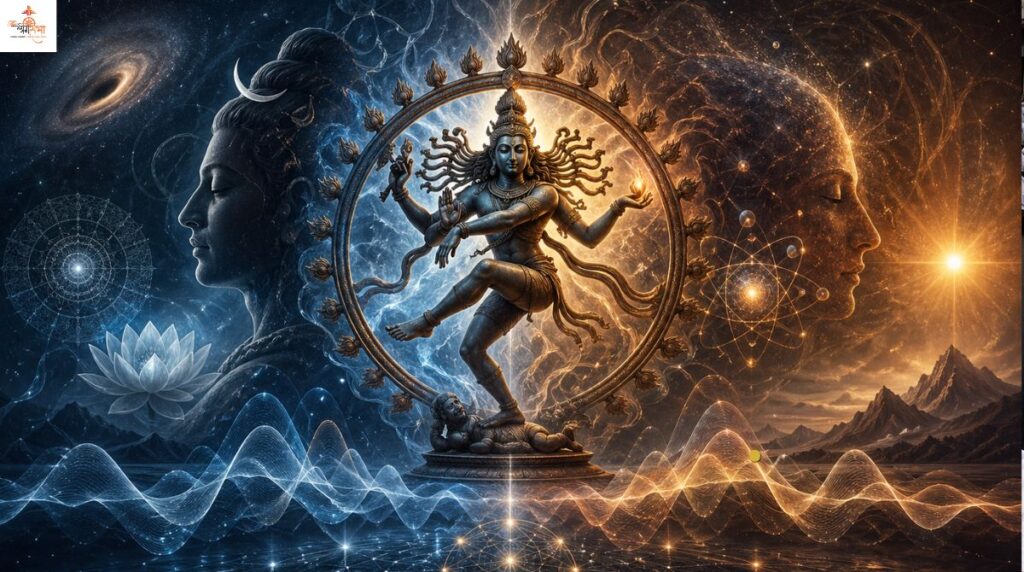
Next, Shiva’s vibrating universe meets the wave function. Trika Darshana’s Spanda, that divine throb, sounds remarkably like quantum fluctuations. The vacuum of space is alive with virtual particles winking in and out. Kashmir Shaivism says the cosmos is the playful vibration of Shiva’s consciousness. Modern physics says the same space is never truly still. It hums with energy. The cosmic dance of Nataraja, Shiva’s iconic form with one foot raised in rhythm, suddenly looks like a perfect symbol for quantum fields.
Entanglement echoes non-duality in a striking way. When particles link across vast distances, they act as one system. Advaita teaches there is ultimately no separation between any two things. Maya makes us see divisions, but the truth is oneness. Trika adds that this oneness is dynamic and full of love. Quantum non-locality feels like a scientific whisper of the same idea. Two distant things that were once connected remain mysteriously one.
Superposition reminds us of Maya’s dream-like quality. A particle in many states at once mirrors the way the world appears multiple and changing while resting in one underlying reality. When the measurement happens, the many possibilities collapse into one experienced world, much like waking from a dream reveals the single mind that dreamed it all.
Even the uncertainty principle finds company in these philosophies. They teach that ultimate reality cannot be fully pinned down by concepts or measurements. The Tao Te Ching and the Upanishads both say the real cannot be named completely. Quantum limits on knowledge feel like a scientific version of that ancient humility.
These meetings are not proofs. They are invitations to wonder. The ancient texts used meditation and insight. Physics uses math and machines. Both peel back layers and reveal a cosmos that feels alive, interconnected, and somehow aware
When Particles Forget Who They Are: The Bose Connection
No story of East meeting West in physics would be complete without two remarkable Indian minds: Jagadish Chandra Bose and Satyendra Nath Bose. Though not blood brothers, they are fondly remembered as the Bose duo whose groundbreaking work carried the spirit of ancient Indian oneness into the heart of modern science. Their contributions did far more than add new facts to textbooks. They embodied a quiet revolution, showing how Vedantic vision of unity could inspire concrete discoveries that still shape our world.
Jagadish Chandra Bose, born in 1858 in Mymensingh (now in Bangladesh), grew up in a Brahmo Samaj family deeply rooted in Advaita Vedanta principles. The Brahmo movement blended ancient non-dual wisdom with modern reason. For Bose, this was not abstract philosophy. It became the guiding light for his science. He refused to see the world as divided into living and non-living, conscious and mechanical. Instead, he pursued the grand unity proclaimed in the Vedas: “Ekam sat vipra bahudha vadanti” – Truth is One, though the wise call it by many names.
Bose’s laboratory work brought this vision alive. In 1902 he published Responses in the Living and Non-Living, a book that stunned the scientific community. Using his own invention, the crescograph, he recorded the tiniest growth movements in plants with astonishing precision. He showed that plants react to electric shocks, heat, chemicals, and even wounds with electrical pulses remarkably similar to animal nerves. More boldly, he demonstrated that metals and minerals also exhibit “fatigue” after repeated stimulation and “recover” after rest, just as living tissues do.
In public demonstrations, Bose would attach his sensitive instruments to a piece of tin or a plant leaf. The audience watched in wonder as both showed identical response curves. For Bose, this was living proof of the Vedantic truth that one life pulses through all matter. There is no sharp line separating kingdoms of nature. The entire cosmos is one responsive, interconnected whole. He often said in lectures that the universe is not a collection of dead objects but a vast organism throbbing with the same vital force.
This perspective was revolutionary at a time when Western science drew rigid boundaries. Bose faced skepticism and even ridicule from some European peers who found it too “mystical.” Yet his work laid early foundations for what we now call plant neurobiology and biophysics. Today, scientists study how plants communicate through electrical and chemical signals, confirming many of Bose’s observations. His insistence on unity also extended to technology. He built the first practical microwave transmitter and demonstrated wireless transmission years before Marconi gained widespread credit, always emphasizing science as a bridge between cultures rather than a tool of empire.
Satyendra Nath Bose, born in 1894 in Kolkata, walked a parallel yet distinct path. He studied under teachers including Jagadish Chandra Bose himself at Presidency College, absorbing the same spirit of bold inquiry and cultural confidence. While Jagadish explored unity across living and non-living realms, Satyendra plunged into the quantum realm where particles themselves seem to dissolve individual identity.
In 1924, the younger Bose made a daring move. Frustrated with classical ways of explaining blackbody radiation, he wrote a short four-page paper deriving Planck’s law from a radically new perspective. He treated photons not as distinguishable classical particles but as completely indistinguishable entities. In his counting method, swapping two identical photons made no difference. This simple shift removed the need for classical assumptions and produced the correct radiation formula elegantly.
He sent the paper to Albert Einstein with a humble letter. Einstein immediately recognized its importance. He translated it into German, got it published, and then extended the idea to atoms, predicting a new state of matter where particles lose their separate identities and merge into a single quantum wave.
That prediction became the famous Bose-Einstein condensate, first created in laboratories in 1995. At near absolute zero, thousands of atoms behave as one coherent whole, forgetting their individual “selves.”
The philosophical echo is profound. In Advaita Vedanta and Trika Darshana, the individual ego or jiva dissolves into the universal consciousness, realizing it was never truly separate.
Satyendra Nath Bose’s statistics revealed that quantum particles already operate on this principle of oneness. They are not isolated billiard balls but excitations of an underlying field, happy to crowd into the same state in ways classical objects never could. Paul Dirac later named such particles “bosons” in his honor, and the term lives on in everything from the Higgs boson to theories of the early universe.
Both Boses carried an Indian sensibility into global science without ever being overt preachers. Jagadish sought the unity of life across apparent boundaries. Satyendra revealed the unity of particles in the quantum realm. Their work did not quote scriptures in lab notes, yet the underlying intuition of non-duality and cosmic interconnectedness clearly shaped their creative leaps. In an era of colonial rule, they demonstrated that Indian minds could not only master Western physics but enrich it with fresh vision born from ancient soil.
Together, they form a living bridge. Jagadish showed the responsive pulse in plants and metals that mirrors Spanda, the divine vibration of Kashmir Shaivism. Satyendra showed particles forgetting who they are, echoing the recognition (Pratyabhijna) that the many arise from and return to the One. Their combined legacy reminds us that great science often springs from deep cultural roots and a sense of wonder at the unity behind diversity. In their hands, the ancient dance of Shiva found new expression in microwave signals and quantum statistics, proving that wisdom from the past can still illuminate the frontiers of tomorrow.
When Particles Forget Who They Are: The Bose Connection and Beyond
No story of East meeting West in physics would be complete without two remarkable Indian minds: Jagadish Chandra Bose and Satyendra Nath Bose. Though not related by blood, they are fondly remembered as the Bose duo whose groundbreaking work carried the spirit of ancient Indian oneness into the heart of modern science. Their contributions embodied a quiet revolution, showing how the Vedantic vision of unity could spark concrete discoveries that still shape our world today.
Jagadish Chandra Bose (1858–1935) grew up in a Brahmo Samaj family steeped in Advaita Vedanta principles. He refused to accept sharp divisions between living and non-living things. In 1902, he published the groundbreaking book Responses in the Living and Non- Living. Using his own invention, the crescograph, he recorded the tiniest movements in plants and showed they respond to stimuli with electrical pulses much like animal nerves. Even more astonishing, he demonstrated that metals and minerals show similar patterns of “fatigue” and “recovery.”
In lively public demonstrations, audiences watched in amazement as a tin plate and a plant leaf produced nearly identical response curves on his instruments. For Bose, this was clear evidence of the Vedantic truth that one life pulses through all matter. The entire cosmos is one responsive, interconnected whole. He often told audiences that the universe is not a collection of dead objects but a vast living organism throbbing with the same vital force.
Beyond plants, he built the first practical microwave transmitter and demonstrated wireless signaling years before Marconi received full credit, always viewing science as a bridge between cultures.
Satyendra Nath Bose (1894–1974), who studied under Jagadish Chandra Bose at Presidency College, took this spirit of unity into the quantum realm. In 1924, he sent a short, elegant four-page paper to Albert Einstein. Instead of treating photons as ordinary distinguishable particles, he considered them completely indistinguishable. This simple but radical shift allowed him to derive Planck’s blackbody radiation law in a new way. Einstein was so impressed that he personally translated the paper, got it published, and extended the idea to atoms.
This work gave birth to Bose-Einstein statistics and predicted a new state of matter known as the Bose-Einstein condensate. In this state, cooled atoms lose their individual identities and behave as a single quantum wave. Particles literally “forget who they are” and merge into one coherent whole. The philosophical resonance is beautiful. In Advaita Vedanta and Trika Darshana, the limited self dissolves into universal consciousness. Satyendra Nath Bose’s discovery showed that quantum particles already follow this principle of oneness at the deepest level. Paul Dirac later honored him by naming such particles “bosons,” a term now famous in everything from the Higgs boson to our understanding of the early universe.
Indian Women Physicists Who Carried the Flame Forward
This inspiring legacy did not stop with the Boses. It flowered further through pioneering Indian women who shattered glass ceilings and brought the same sense of wonder and interconnected reality to physics.
Bibha Chowdhuri (1913–1991) became India’s first woman particle physicist. Working with D.M. Bose in the late 1930s, she set up high-altitude nuclear emulsion experiments in the Himalayas. She was among the first to detect and study new particle tracks, contributing important early evidence for mesons and helping validate Hideki Yukawa’s theory. She went on to earn her PhD at the University of Manchester under Nobel laureate P.M.S. Blackett, studying extensive air showers. At the Tata Institute of Fundamental Research (TIFR), she became the first woman scientist on the faculty and continued cosmic ray research at places like the Kolar Gold Fields. Her patient work tracking invisible high-energy particles reflected a deep fascination with the hidden vibrating energies that shape our universe.
Anna Mani (1918–2001) worked directly with C.V. Raman on the spectroscopy of diamonds and rubies. She later joined the India Meteorological Department and designed more than 100 indigenous weather instruments, including ozonesondes for measuring the ozone layer. Her instruments helped India become self-reliant in meteorology and contributed vital data to global understanding of solar radiation, wind energy, and atmospheric processes. Mani’s practical genius embodied the Vedantic view of a responsive cosmos where even the air around us pulses with measurable life and intelligence.
Purnima Sinha (1927–2015), guided by Satyendra Nath Bose himself, became the first woman to earn a PhD in Physics from Calcutta University in 1956. With limited resources, she built her own X-ray equipment from World War II army surplus scrap found on Kolkata streets. She studied the structure of Indian clay and later contributed to biophysics at Stanford and the physics of ceramics. Her creative perseverance beautifully illustrated the unity of mind and matter.
In more recent decades, Aditi Sen De has made outstanding contributions to quantum information, entanglement, and quantum communication, earning the prestigious Shanti Swarup Bhatnagar Prize. Tanusri Saha-Dasgupta, the first woman director of the S.N. Bose National Centre for Basic Sciences, advances computational quantum materials, sensors, and condensed matter physics. These women continue to expand the very frontiers where quantum weirdness meets the living unity celebrated in ancient wisdom.
The combined legacy of the Boses and these remarkable women physicists shows that great science often springs from deep cultural roots and a profound sense of wonder at the unity behind diversity. Jagadish revealed the responsive pulse in plants and metals that mirrors Spanda. Satyendra showed particles forgetting individual identity, echoing Pratyabhijna. Bibha, Anna, Purnima, Aditi, Tanusri, and many others added their own rich harmonies through cosmic rays, atmospheric rhythms, and quantum insights. In challenging times of colonial rule and social barriers, they proved that Indian minds, both men and women, could master global physics and enrich it with fresh vision born from ancient soil.
The ancient dance of Shiva found powerful new expression in microwave signals, quantum statistics, particle tracks, weather instruments, and entanglement studies. These Indian pioneers remind us that wisdom from the past still brightly illuminates the frontiers of tomorrow.
What This Means Today: Implications, Critiques, and the Road Ahead
So what does all this mean for us in the 21st century? The parallels invite us to see science and spirituality as partners rather than rivals.
Practically, recognizing consciousness as fundamental could reshape fields like neuroscience, artificial intelligence, and even ecology. If awareness is woven into reality, then treating the planet as a living whole makes scientific sense. Meditation practices from Trika, which emphasize recognition and presence, might one day complement therapies for mental health. Quantum technologies, from computers to sensors, already change our world. Understanding their philosophical depth could guide ethical development.
Critiques keep us honest. Some scientists warn against cherry-picking parallels. Quantum effects usually fade in the warm, messy world of daily life. Ancient texts are not scientific papers. Overstating connections risks pseudoscience. Others note that consciousness in quantum interpretations remains a minority view. Most physicists focus on math and predictions, not metaphysics.
Still, the conversation grows richer. Thinkers from Erwin Schrödinger, who openly drew from Vedanta, to today’s researchers exploring consciousness studies keep the dialogue alive. The road ahead looks bright. Interdisciplinary teams of physicists, philosophers, and contemplative practitioners could explore these ideas together. New experiments might test whether focused awareness influences quantum systems in subtle ways. Meanwhile, ancient practices could inspire fresh ways to experience the unity physics describes.
The real gift is humility and wonder. We are not separate observers of a dead machine. We are participants in a living, vibrating cosmos. That realization changes how we live, how we treat one another, and how we care for the only home we have.
Key Points: How Harvard-Trained Quantum Physicist Dr. Mrittunjoy Guha Majumdar Explains Hinduism (Sanatan Dharma)
Dr. Mrittunjoy Guha Majumdar (Cambridge PhD, former Harvard postdoctoral researcher, collaborator with Nobel Laureate Brian Josephson) is a practicing quantum physicist and author of the bestselling book From Shiva to Schrödinger. In his widely watched Hyper Quest Podcast episode (“Is Hinduism True?”) and other talks, he explains core aspects of Hinduism focusing on Advaita Vedanta and especially Kashmir Shaivism (Trika Darshana) through the lens of modern quantum physics. He stresses resonances and complementary insights, never claiming science “proves” Hinduism.
1. Consciousness (Chit / Chaitanya) as the Primary Reality
Pure consciousness (Brahman or Shiva) is the fundamental ground of existence the basis on which everything is built, not an emergent property of matter.
Quantum mechanics’ measurement problem and observer effect suggest consciousness may play a key role in actualizing reality from possibilities.
2. Non-Duality (Advaita / Abheda) and Quantum Interconnectedness
Advaita’s teaching “Tat Tvam Asi” (You are That) says the world is an appearance within one undivided reality.
This parallels quantum entanglement and non-locality: particles remain correlated across distances, showing separation is not fundamental.
3. Spanda (Cosmic Vibration / Throb) and Quantum Vacuum Fluctuations
Trika Shaivism’s Spanda the eternal pulsation of consciousness mirrors quantum vacuum fluctuations and zero-point energy.
“Empty” space is alive with constant vibrations and virtual particles, echoing Shiva’s dynamic self-expression through Shakti.
4. Pratyabhijna (Recognition) and the Observer Effect
Pratyabhijna is the direct recognition that your innermost awareness is Shiva, which transforms experience.
This resonates strongly with the quantum observer/measurement effect, where observation collapses probabilities into definite outcomes.
5. Maya / Ābhāsa and Quantum Superposition
The world of appearances (Maya in Advaita, Ābhāsa or self-projection in Trika) mirrors quantum superposition multiple possibilities exist until observed or experienced.
Trika views the world as a real playful expression of Shiva, not mere illusion.
6. Svātantrya (Absolute Freedom) and Quantum Indeterminacy
Consciousness has complete creative freedom to manifest possibilities.
This aligns with Heisenberg’s uncertainty principle and the probabilistic, open nature of quantum reality.
7. Trika Shaivism as Particularly “Quantum-Friendly” (“Quantrika”)
Dr. Majumdar highlights Trika as dynamic, world-embracing, and sophisticated more aligned with quantum ideas than purely static interpretations.
He playfully calls the quantum-like principles in Trika “Quantrika” non-duality, vibration, recognition, and freedom already mapped centuries ago.
8. Science and Dharma as Complementary Paths
Ancient Indian Darshanas (Advaita, Trika, Samkhya, etc.) explored consciousness, reality, and emergence long before modern experiments.
Physics provides empirical tools and metaphors; Hindu philosophy offers experiential depth and a participatory, conscious view of the cosmos.
Move beyond “science vs. religion” to a mature, evidence-based dialogue.
Overall Message: Hinduism, especially its non-dual traditions, offers a profound map of reality that quantum physics is now beginning to echo. The goal is wonder and deeper understanding not proving one with the other. Dr. Majumdar encourages both scientific rigor and direct meditative experience
Conclusion
From Shiva’s cosmic dance to the shimmering waves of quantum possibility, the journey reveals a universe far more intimate than we once imagined. Advaita Vedanta reminds us of the one reality behind all appearances. Trika Darshana invites us to feel the joyful pulse of that reality in every breath. Quantum physics hands us the tools to see the same truth dancing in laboratories and equations.
The Bose brothers, with their brilliant Indian minds, showed that this meeting is not abstract. It lives in real discoveries that still power our technology and stretch our imagination.
None of this demands we abandon reason or faith. It simply asks us to look with open eyes and open hearts. The next time you watch a sunset, feel the breeze, or wonder about the tiny particles inside your own body, pause. You might sense the ancient pulse still beating, the same pulse that scientists measure today in quantum fields.
The dance continues. The wave function still hums with possibility. And you, dear reader, are not outside the performance. You are part of the music. May that realization fill your days with wonder, curiosity, and a deep sense of belonging to this magnificent, aware cosmos.
The sages and the scientists agree: the universe is alive, and so are we. Let us keep dancing together.