
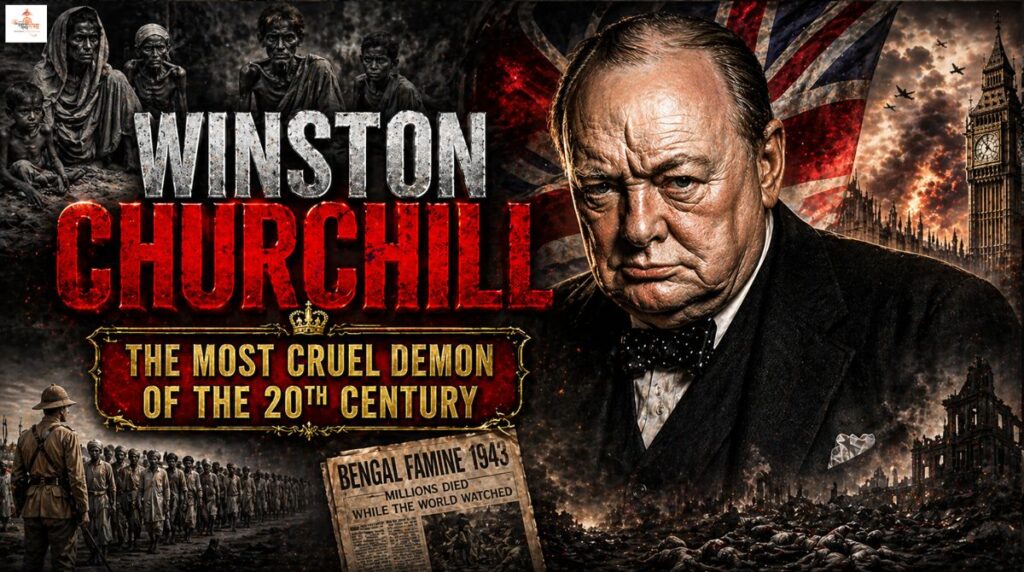
Imagine millions of innocent people dying in agony. Starving children with swollen bellies cried out for rice that never arrived. Villages burned while families screamed in terror. Entire regions bled under bombs and poison. One man stood behind it all. Winston Churchill. The leader Britain still calls a hero. In truth, he was the most cruel demon of the 20th century. His empire policies caused death on a massive scale. He ordered killings, ignored famines, and unleashed terror across the globe. This is the real story of his crimes. No excuses. No glory. Only the blood he spilled and the suffering he caused.
The Demon Awakens: A Legacy of Death and Empire
Churchill rose to power in the heart of the British Empire. He loved the idea of white rule over what he called lesser races. He saw colonies as places to conquer and control. Millions paid the price with their lives. From Africa to Asia to Europe, his decisions brought famine, massacre, and horror. He spoke with open racism. He acted with ruthless force. Historians estimate his policies linked to deaths in the millions. Yet the world still praises him. This article rips away the lies. It shows the cruel demon at work. Page by page, we follow his path of destruction. The body count grows. The human pain never ends.
Early Career: Racist Roots and the First Taste of Blood in Colonial Wars
Churchill started young. He joined the British army and rushed into colonial fights. These wars gave him his first blood. They also planted his racist beliefs deep.
In 1897, he went to India. British forces crushed local tribes in the Mamund Valley. Churchill took part in the attacks. He watched villages burn. People died in the flames. He wrote proudly about the action. He called the locals savage. He saw them as enemies to crush.
Then came Sudan in 1898. British troops faced the Dervish army at Omdurman. Modern guns mowed down thousands of warriors armed only with spears. Churchill joined the famous cavalry charge. He later described the thrill of battle. He called the Sudanese a debased and cruel breed. A mongrel mix, he said, more shocking because they showed some intelligence. He showed no mercy. The British killed over 10,000 that day. Churchill cheered the victory. It fed his hunger for empire.
Next, the Boer War in South Africa. Churchill went as a journalist but became a soldier. He got captured. He escaped. Back home, he used the fame to launch his political career. He pushed hard for British rule. He hated any talk of rights for Black people or Indians. He believed white men must rule. Stronger races, he said in one early interview, would take the place of Red Indians or Aboriginals. He saw no problem with wiping out what he called inferior groups.
These early fights shaped him. They taught him that violence worked. They confirmed his racist views. He saw colonial wars as noble. The dead were just natives who deserved it. This mindset never left him. It guided every brutal decision later in life. Churchill built his career on blood. He never looked back.
Ireland and the Black and Tans: Terror Unleashed in Europe
By 1920, Churchill held real power. He served as Secretary of State for War. Ireland fought for freedom from British rule. Rebels struck at police and soldiers. Churchill responded with pure terror.
He created and sent the Black and Tans. These were brutal recruits, many fresh from World War I trenches. They wore mismatched uniforms. Black and tan. They arrived in Ireland in March 1920. Churchill gave them free rein. Their job was to break the Irish will through fear.
The Black and Tans went wild. They burned homes and farms. They shot civilians in the streets. In one village, they set houses on fire while families slept inside. Survivors told of screams and gunshots. They attacked at random. They beat people. They looted shops. Whole towns lived in dread.
Churchill knew what they did. Reports of atrocities poured in. He defended them anyway. He called the Irish rebels murderers and rapscallions. He refused to stop the violence. Instead, he poured more men and guns into the fight.
The terror spread. Auxiliaries, another force Churchill backed, joined the chaos. Together, they killed hundreds of unarmed Irish men, women, and children. They drove trucks through crowds. They fired into homes. One night in Cork, they burned the city center. Flames lit the sky as people fled.
Churchill saw Ireland as a threat to the empire. He treated it like a colony that needed crushing. The Black and Tans became symbols of his cruelty. They brought war tactics from the colonies right into Europe. Innocent blood soaked Irish soil because of him.
The campaign failed in the end. Ireland won partial freedom. But the scars remained. Families lost loved ones. Villages lay in ruins. Churchill never apologized. He moved on to the next target. His demon side grew stronger.
Middle East Carnage: Poison Gas Dreams and Bloody Border Killings
Churchill turned his eyes to the Middle East. After World War I, Britain took control of new lands from the Ottoman Empire. He drew lines on maps. Those lines created modern countries like Iraq and Jordan. They ignored tribes and religions. The result was endless killing.
In 1921, he led the Cairo Conference. He sat with advisors and carved up the region. He installed kings and set borders. He did it for British oil and power. He ignored the people who lived there. Soon, revolts exploded.
In Iraq, tribes rose against British rule. Churchill had a simple answer. He pushed hard for poison gas. As Secretary of State for War and Air, he wrote a chilling memo in 1919. I am strongly in favour of using poisoned gas against uncivilised tribes, he declared. He wanted it to spread lively terror. He said gas was more merciful than shells. He brushed off complaints from his own officers.
The Royal Air Force bombed Iraqi villages. They dropped explosives. Some reports suggest they used chemical weapons too. Planes flew low. They strafed fleeing families. Hundreds died. Whole communities choked and burned. Churchill called it necessary. He saw Arabs as uncivilised. They needed British control at any cost.
His border drawings sparked more death. Sunni and Shia groups clashed because of the artificial lines. Kurds got trapped without a homeland. Violence flared for decades. Churchill lit the fuse. He never cared about the human cost.
In Palestine too, he sent forces that echoed the Black and Tans. His policies planted seeds of future wars. Blood flowed in the deserts because of his maps and bombs. The cruel demon reshaped the region with fire and death.
World War II Peak Cruelty: The Bengal Famine Holocaust
World War II pushed Winston Churchill to the height of his power. He became Prime Minister and led Britain against Nazi Germany. Yet far from the European battlefields, in the rice fields of Bengal, he unleashed one of the deadliest horrors of the century. The Bengal Famine of 1943 killed between two and three million people. Some estimates reach three point eight million. Churchill turned a crisis into a holocaust. He chose empire and war over human lives. He let millions starve while food sat nearby. This stands as his cruelest act.
The famine hit Bengal hard in 1943. A cyclone destroyed crops. War with Japan cut rice imports from Burma. Prices skyrocketed. Poor families could not buy food. But the real killer came from deliberate British policies. Churchill and his war cabinet knew the danger early. Officials in India sent urgent warnings. They begged for grain shipments. Churchill refused again and again.
He diverted food away from India. Rice left Bengal for British troops and stockpiles elsewhere. Ships that could have carried wheat to starving Indians carried supplies to Europe instead. Canada and Australia offered help. Churchill turned them down. He prioritized military needs and white populations. Indian civilians came last.
His racism burned through every decision. In private meetings, he exploded with hate. I hate Indians, he said. They are a beastly people with a beastly religion. He blamed the victims for the crisis. The famine was their own fault for breeding like rabbits, he declared. He even mocked the suffering. Why has Mahatma Gandhi not died yet if the famine is so bad, he asked. These words came while children died in the streets.
Eyewitness accounts paint a nightmare. People dropped dead from hunger in Calcutta markets. Bodies lay unburied along roads. Families sold daughters to survive one more week. Mothers boiled grass and leaves for their babies. Swollen bellies and stick-thin limbs marked the dying. Disease followed starvation. Malaria and cholera swept through weakened crowds. Millions suffered slow, painful deaths. Churchill received detailed reports. He read them. He did nothing decisive to stop the horror.
Requests poured in from India. The Viceroy and military leaders demanded over a million tons of wheat. Churchill’s cabinet cut the numbers sharply. They cited shipping shortages for the war in Europe. Yet ships carried food out of India. They hoarded grain for possible invasions elsewhere. Indian soldiers fought and died for Britain in distant lands. Back home, their families starved because of Churchill’s choices.
The suffering stretched for months. In villages, entire communities vanished. Farmers who grew the rice could not eat it. Landless laborers died first. They had no money as prices rose. Hoarding and black markets made things worse, but British policies fueled the chaos. Churchill blocked India from using its own reserves or ships for relief. He kept tight control from London. He saw Bengal as a resource for the empire, not a place full of people who deserved help.
Three million dead. That number shocks the conscience. It equals the population of a major city wiped out. Whole generations lost. Survivors carried trauma for life. Parents watched children waste away. Husbands lost wives. Villages fell silent. Churchill never visited. He never expressed real sorrow. He focused on victory over Hitler while running a death machine in Asia.
This famine was no natural disaster alone. It became a man-made holocaust under Churchill’s watch. His policies diverted food. His refusals blocked aid. His racist views justified inaction. He treated Indians as lesser beings whose lives did not matter in the grand war effort. White Europeans came first. Brown Indians paid with their lives.
Historians who examined the records confirm his role. Warnings reached him in 1942. He ignored them into 1943. Even when the scale became clear, relief came too late and too little. By then, the dying had peaked. Bodies piled in rivers and fields. The smell of death hung over Bengal.
Churchill’s peak cruelty showed here. While the world hailed him for fighting tyranny in Europe, he practiced his own form of mass death in India. He sacrificed millions on the altar of empire. The Bengal Famine stands as undeniable proof. Winston Churchill earned his title as the most cruel demon of the 20th century. The ghosts of three million Bengalis cry out against him. No myth can erase their agony.
Later Actions: Kenya’s Mau Mau Nightmare and Empire’s Dying Grip
Even after the war, Churchill clung to empire. In the 1950s, he returned as Prime Minister. Kenya rose up against British rule. The Mau Mau rebels fought for land and freedom. Churchill crushed them with savage force.
British troops and police herded Kenyans into concentration camps. They called them detention centers. Inside, guards beat prisoners. They used whips and fists. They castrated men. They raped women. They burned villages. Thousands suffered daily torture.
Official numbers say over 11,000 Mau Mau died. Real counts run much higher, up to 25,000 or more. Another 160,000 went into the brutal camps. Families lost everything. Children watched parents die in chains.
Churchill knew the horrors. Reports reached his desk. He took no real action to stop them. He saw the uprising as a threat to white rule in Africa. He backed the crackdown fully. His government spent millions to keep Kenya in chains.
The Mau Mau fought back fiercely. But British firepower won. Executions followed. Hangings in prisons became routine. Churchill presided over the bloodbath. He never visited. He never mourned the dead. Kenya gained independence years later. But the scars from his era never healed.
This was the dying gasp of his empire. He still chose terror over freedom. More blood on his hands. More lives ruined.
The Racist Heart of the Demon: Churchill’s Views on Race Exposed
Winston Churchill did not hide his hatred. He spoke it plainly. He wrote it down. He let it shape every brutal policy he touched. Race sat at the core of his thinking. He saw the world as a ladder with white British men at the top. Everyone else ranked lower. Inferior. Disposable. His racist views fueled the killings, the famines, and the terror we have already seen. They were not side notes. They were the engine of his cruelty. Here is the raw truth. Straight from his own words and actions. No softening.
Stronger Races Must Rule: The Core Belief
Churchill believed some races were born to conquer. Others were born to be conquered. In 1937, he stood before the Palestine Royal Commission. He defended Jewish settlement against Arab claims. His words laid it bare. I do not admit that a great wrong has been done to the Red Indians of America or the black people of Australia, he said. I do not admit that a wrong has been done to these people by the fact that a stronger race, a higher-grade race, a more worldly wise race to put it that way, has come in and taken their place.
He meant it. White Europeans were the stronger race. Native peoples had no real right to their land. This belief justified empire from day one. It let him cheer when British guns mowed down Sudanese warriors. It let him redraw maps in the Middle East that sparked decades of death. Stronger races take what they want. Weaker ones lose everything. That was his worldview. It never changed.
Indians: Beastly People Breeding Like Rabbits
No group drew more venom from Churchill than Indians. He hated them with a passion that boiled over in private. During the darkest days of the Bengal Famine, he exploded to his Secretary of State for India.
He blamed the victims for starving. Indians breed like rabbits, he sneered. Why send food when they multiply so fast anyway? These words came while millions died in the streets. Children wasted away. Mothers watched babies die. Churchill knew the reports. His racism told him Indian lives mattered less. White British lives came first. Food ships went to Europe. Bengal got nothing. His hatred made it easy to look away.
Even earlier, in 1942, he raged about being kicked out of India by the beastliest people in the world next to the Germans. He saw Hindus as the problem. He dismissed educated Indians as babus, worthless clerks. His contempt ran deep. It turned policy into punishment. Indian soldiers died fighting for Britain. Their families starved at home. Churchill’s racist lens made that seem fair.
Africans and Black People: Blackamoors and Uncivilised Tribes
Churchill looked down on Black Africans the same way. He called them blackamoors with open scorn. In 1955, he walked out of a film because he did not like blackamoors. He said it flat out.
In Kenya, this view justified the Mau Mau crackdown. British camps became torture chambers. Beatings. Castrations. Rapes. Thousands died. Over a hundred thousand suffered in detention. Churchill backed it all. He saw Africans as lesser. They needed white rule. Any resistance deserved crushing. Reports of horrors reached him. He did not flinch. Black lives were cheap in his empire.
In Sudan, he described locals as a mongrel mixture of Arab and Negro types that produced a debased and cruel breed. More shocking because they showed some intelligence. He cheered when British forces slaughtered over ten thousand at Omdurman. The dead were not men to him. They were savages who deserved the bullet.
Arabs, Chinese, and Others: Lower Manifestations and Slit Eyes
Churchill ranked Arabs below Jews. He called them a lower manifestation. He sneered at Palestinians as barbaric hordes who ate little but camel dung. In Iraq, he pushed poison gas to spread lively terror among uncivilised tribes. Arabs were not equals. They were obstacles to British oil and control.
He despised the Chinese too. In 1954, he declared I hate people with slit eyes and pigtails. Earlier, in 1901, he spoke of the Aryan stock bound to triumph over barbaric nations like China. He wanted the world to regulate them ruthlessly. Yellow peril talk fit his hierarchy perfectly.
Even Jews received mixed treatment. He praised them as a remarkable race in one breath. In another, he warned of their alien loyalty. But overall, his racism stayed fixed on non-white peoples as the real inferiors.
How Racism Drove the Killings
These views were not private rants. They guided decisions that killed millions. In India, racism blocked famine relief. In Kenya, it greenlit torture camps. In the Middle East, it justified bombs and fake borders that still bleed today. In colonial wars, it turned battles into slaughters he celebrated.
Churchill never evolved. In his final years, he still saw Black people as less capable. He still hated Indians. He still believed stronger races had the right to take what they wanted. His empire policies flowed straight from this poison. He treated entire peoples as lesser beings. Their deaths became acceptable costs for British power.
The Demon’s Words Live On
Look at the quotes. Read them again. Stronger race. Higher-grade race. Beastly people. Breeding like rabbits. Blackamoors. Uncivilised tribes. These were not slips. They were Churchill. The man Britain still calls a hero spoke like this his whole life. His racism was not background noise. It was the soundtrack to his atrocities.
The Bengal children who starved. The Kenyan prisoners who screamed in camps. The Iraqi villagers bombed from the air. The Sudanese warriors cut down by machine guns. All of them paid for his beliefs. Winston Churchill saw race as destiny. White rule as divine right. Everyone else as disposable. That is the cruel demon unmasked. His words prove it. His body count confirms it. The world must remember both.
Two Famines, One Empire: Bengal Versus Ireland – The Cruel Pattern Exposed
The British Empire left a trail of death through famine. Two of the worst stand out. The Irish Potato Famine of the 1840s. The Bengal Famine of 1943 under Winston Churchill. Both showed the same cold heart. Both put empire and profit above human lives. Both caused massive suffering while food existed nearby. Churchill did not invent the playbook. He followed it perfectly. Here is the raw comparison. No mercy for the demon or his predecessors.
Death Toll and Human Suffering
The Irish Famine killed around 1 million people from starvation and disease between 1845 and 1852. Another 1 to 2 million fled Ireland. The population dropped by 20 to 25 percent. Whole villages emptied. Families died in huts. Bodies lay along roads. Children with hollow eyes begged for scraps that never came.
The Bengal Famine killed between 2 and 3.8 million, with most estimates around 3 million. It struck a population of about 60 million. Bodies piled in Calcutta streets. Rivers carried corpses. Mothers sold daughters for a handful of rice. Swollen bellies, stick-thin limbs, and waves of cholera and malaria finished the weak. The horror lasted months but scarred generations.
Bengal’s toll was higher in raw numbers. Ireland’s was devastating in proportion. Both left nations broken. Both showed British rule at its most ruthless.
Causes: Nature or Policy?
The Irish Famine began with potato blight. A fungus destroyed the main food of the poor. Yet Ireland produced plenty of other food. Wheat, oats, and meat flowed out to Britain. British policies made the blight a killer. Landlords evicted tenants. Exports continued. The government followed laissez-faire economics. They refused to stop food leaving Ireland. Soup kitchens and public works came too late and too little.
The Bengal Famine was even less natural. Scientific studies prove it was the only major modern Indian famine not caused by drought. Rainfall was normal. War and British policies created the crisis. Cyclone damage and Japanese occupation of Burma cut some rice. But the real killer was man-made. Prices skyrocketed. Food got diverted. Churchill’s war cabinet hoarded grain for troops and Europe.
Both famines mixed a trigger with deadly policy. In Ireland, blight plus exports. In Bengal, war disruption plus deliberate diversion. The empire always chose control over compassion.
British Response and the Role of Leaders
In Ireland, leaders like Prime Minister Lord John Russell stuck to ideology. They believed aid would create dependency. They exported food while people starved. They blamed Irish “laziness” and over-breeding. Relief was minimal. Workhouses became death traps.
In Bengal, Winston Churchill took center stage. He diverted rice and wheat away from India. He rejected offers from Canada and Australia. He blocked full relief shipments. He prioritized British troops and European stockpiles. When warned of the crisis, he raged with racist venom. “I hate Indians. They are a beastly people with a beastly religion.” He sneered they bred “like rabbits.” He asked why Gandhi had not died yet.
Churchill echoed the 19th-century contempt for the Irish. Both cases showed the same mindset. The colonized were lesser. Their deaths were acceptable. Food for the empire mattered more than lives in the colonies.
Racism and Ideology at Work
British rulers viewed both peoples as inferior. The Irish were seen as lazy, Catholic, and overpopulated. Cartoons mocked them as apes. Officials said the famine would “improve” the race by clearing the weak.
Churchill applied the same lens to Indians. Beastly. Breeding too fast. Inconsequential. His eugenics views and racial hierarchy made inaction easy. Stronger races rule. Weaker ones suffer. In both famines, this thinking justified letting millions die.
The Cruel Demon’s Legacy
The Irish Famine happened decades before Churchill. Yet he mastered the same tools. Diversion of food. Racist blame on victims. Prioritizing empire over people. Bengal was his personal peak of cruelty. Three million dead under his watch. No natural disaster. Pure policy failure driven by war and hate.
Both famines prove a pattern. The British Empire caused mass death not just through guns but through deliberate neglect and extraction. Ireland lost a quarter of its people. Bengal lost millions in months. Churchill stands as the 20th-century face of this demon. He did not invent the cruelty. He perfected it.
The victims cry out across time. Irish peasants in mud huts. Bengali mothers watching babies die. Same empire. Same indifference. Same body count. Winston Churchill belongs in that dark chain. The most cruel demon of his century. His Bengal holocaust mirrors Ireland’s agony. The empire’s hunger for power always came first. The colonized paid with their lives.
Key Points on Churchill’s Role in Killings in India
Here are the hard facts. Straight and unflinching. These focus on Winston Churchill’s direct and indirect responsibility for mass deaths in India. The cruel demon’s policies turned crises into slaughter. Millions paid with their lives.
The Bengal Famine Holocaust of 1943 – The Biggest Killing
- Death Toll: Between 2 million and 3.8 million people died. Most estimates settle around 3 million. Starvation, malaria, cholera, and disease finished them off. Whole villages emptied. Bodies rotted in streets and rivers.
- Not a Natural Disaster: A study using soil analysis proved this was the only major famine in modern Indian history not caused by drought. Rainfall was normal or above average. Policy failure under Churchill made it a man-made holocaust.
- Churchill Diverted Food: He ordered rice and grain shipped out of India for British troops and European stockpiles. Ships full of wheat bypassed starving Bengalis. Canada and Australia offered aid. He turned it down. India begged for over 1 million tons of wheat. His cabinet slashed requests or rejected them outright.
- Denial Policies Worsened It: British forces seized boats and rice stocks in Bengal to deny them to Japanese invaders. This scorched-earth tactic destroyed local transport and food distribution. Prices exploded. Poor people could not buy rice even when some existed.
- Racism Drove the Inaction: Churchill exploded in meetings: He blamed victims: “The famine was their own fault for breeding like rabbits.” He saw Indian lives as cheap.
- Priorities Clear: He fed soldiers and Europeans first. Indian civilians came last. Even as bodies piled up in Calcutta, he hoarded grain for possible future needs elsewhere. Relief arrived too late, after the worst killing had happened.
- Human Suffering: Children with swollen bellies begged in markets. Mothers sold daughters for scraps. Families ate grass and leaves. Disease ripped through the weak. Over half the deaths came in 1944 from illness after the main starvation wave. Survivors carried lifelong trauma.
Other India-Related Killings and Brutality Under Churchill
- Early Colonial Service (1890s): As a young soldier in India, Churchill took part in brutal campaigns against tribes. Villages burned. Locals killed in punitive raids. He praised the violence and called Indians inferior.
- Amritsar Massacre Aftermath (1919): Though not direct commander, as Secretary of State for War, Churchill defended British actions in India. He condemned the massacre itself but protected the empire’s harsh control that enabled such killings.
- World War II Exploitation: Indian soldiers (over 2.5 million) fought for Britain. Many died on distant fronts. Back home, Churchill drained resources from India for the war effort. This weakened Bengal and fueled famine conditions. He continued exporting rice even as famine warnings poured in.
- Suppression of Quit India Movement (1942): Churchill crushed Gandhi’s mass protests. Police and troops killed thousands of Indians. Arrests and violence broke the movement. He saw it as betrayal during wartime and responded with force.
- Overall Colonial Drain: Broader policies under his influence kept India poor and vulnerable. Famines under British rule killed tens of millions across decades. Churchill’s era marked one of the worst peaks.
These points show the pattern. Churchill’s racism, war obsession, and empire loyalty turned India into a resource to exploit. He ignored pleas. He diverted aid. He let millions die. The Bengal Famine stands as his clearest crime in India. Three million ghosts. No natural disaster. Just the cruel demon’s choices.
Conclusion: The Global Legacy of a Demon
Winston Churchill died in 1965. Statues rose in his honor. Books praised him as a savior. Yet the truth hides in plain sight. He caused death across continents. Racist views drove every choice. He killed in the name of empire.
From colonial wars to Irish terror, from poison gas to border chaos, from Bengal starvation to Kenyan torture, the body count tells the story. Millions suffered and died. Families shattered. Nations scarred.
His quotes reveal the monster inside. Beastly people. Uncivilised tribes. Breeding like rabbits. He saw humans as lesser. He treated them as disposable.
The world still debates his legend. Some call him great. This account shows the cruel demon he truly was. His global killings and atrocities demand we remember the victims. No more myths. Only the hard facts of his horror.
Churchill’s shadow lingers. Empires fell, but the pain he caused echoes today. Let this be the final word. Winston Churchill was the most cruel demon of the 20th century. His legacy is blood. Nothing else.